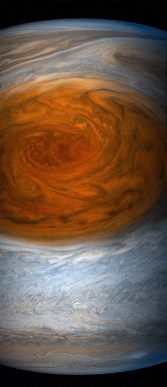
On July 4, 2016, NASA’s Juno spacecraft arrived at Jupiter traveling at a blistering 130,000 mph. Its mission — to orbit the gas giant closer than any craft had done before — was not easy.
Like Earth, Jupiter is surrounded by a field of magnetic radiation. But Jupiter’s is much, much stronger. If Juno didn’t hit a precise region at the poles where the magnetic field is the weakest in its entry, it wouldn’t have survived; the radiation would have fried the craft.
Juno hit its mark, and Scott Bolton, who leads Mission Juno, called it “the hardest thing NASA has ever done.” Since then, Juno has been completing an orbit of Jupiter once every 53 days.
In June, Juno’s mission was approved to continue through at least July 2021. After that, NASA can choose to extend the mission — or it could end it, plunging the craft into Jupiter’s gauzy atmosphere, where it would burn up. If this dramatic ending sounds familiar, it’s because last year NASA crashed Cassini, the spacecraft that orbited Saturn, into that gas giant. It was awesome.

 Make a Black Hole


 Dispatches From The Front