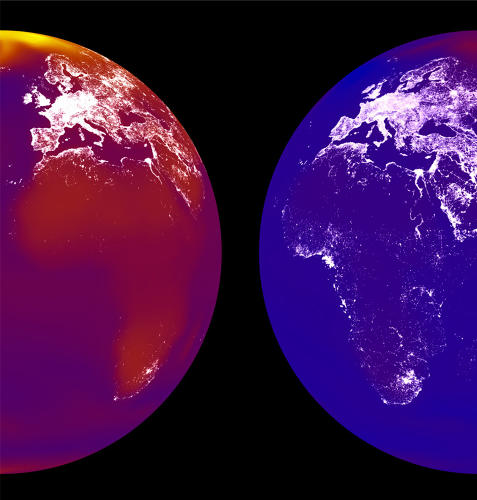
 The slowing down of life on a hot summer day isn’t your imagination. Economic literature is full with examples of how productivity comes to a crawl—even in America’s over-air conditioned society—when the temperatures climb above a given tipping point.
Consider that the number of cars rolling off U.S. auto assembly lines decreases during heat waves. Or that American children have scored lower on math tests that are given when the thermometer rises above 79 degrees. One study found that weekdays above 86 degrees have cost an average of $20 a person in lost economic performance in the U.S. And if temperatures above 85 degrees are sustained over a growing season, yields for crucial crops like corn and soybean in the U.S. drop substantially—a worrisome economic and global food security outcome in a predicted future of hotter summers.
The many trillion dollar question is what happens when all of these individual effects become more frequent as the world’s thermostat rises. How much will climate change cost? And how will it change the economic landscape of the places that aren’t affected by heat-related productivity losses now, but will be soon.
Read More
 U.S. employers added 157,000 jobs in July, and the nation’s unemployment rate fell to 3.9 percent, according to data released Friday by the Labor Department. Meanwhile, average hourly pay for workers rose 2.7 percent from a year earlier, to $27.05 from $26.34.

 Los Angeles Economic Development Corporation’s Institute for Applied Economics has produced a detailed report of where the California manufacturing sector is and where they think it’s headed. A great read for those looking to understand the future of this crucial part of our economy.


 Dispatches From The Front