Trump does not rule out recession as trade war escalates | BBC News

US President Donald Trump has refused to say whether the US economy is facing a recession or price rises in the wake of his administration’s flip-flopping on tariff threats against some of its closest trading partners.

Asked if he was expecting a recession this year, Trump said there was a “period of transition” taking place.

Commerce Secretary Howard Lutnick, however, insisted there would be no contraction in the world’s largest economy, while acknowledging that the price of some goods may rise.

It comes after a volatile week for US financial markets as investors grappled with uncertainty from his administration’s U-turn on some key parts of its aggressive trade policies.

Read More

Stagflation | Getentrepreneurial.com

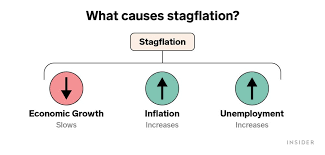
Stagflation is like an imperfect storm, a weather happening with lots of contributing factors. Stagflation is an economic condition caused by a combination of increasing inflation and high unemployment rates, which cause a decrease in consumer demand for goods and services.

In a good economy, there’s a balance, where slow steady economic growth is in step with consumer demand. With Stagflation, the economy is out of balance in a bad way.

Read More

How Businesses Can Survive Inflation and Recession | Inc.com

As we all gradually get over the massive economic and societal hurdles the Covid-19 pandemic brought about, the U.S. economy is sliding into more drama: inflation and recession.

Prices are rising, supply chains are still in turmoil, and customers and business owners alike are pinching every penny as their lives get more expensive. Economists agree that this high inflation could be long-lasting and play a major part in the oncoming recession. They see hard times ahead, particularly for small business owners and new entrepreneurs.

Read More

Bureau of Labor Statistics Chart | Industry Employment

% chg in industry emmployment 6/09 - 3/14

How well are U.S. industries recovering from the last recession? Data from the U.S. Bureau of Labor Statistics BLS show that most industries added jobs between June 2009 and March 2014, a period spanning the end of the recession into the ongoing recovery.

Private service-providing industries added 7.2 million jobs, compared with 0.5 million for goods-producing industries over that period. But, as the chart shows, the mining and logging industry had the greatest percent increase in employment. The next largest percent increase, by nearly half, was for professional and business services. Employment fell in three of the 13 industries in the chart—construction, utilities, and information.

The employment data in the chart are from the BLS Current Employment Statistics program. For more information, visit http://www.bls.gov/ces or call 202 691-6555.