Amazon’s Bargain Button Could Actually Be Good for the Economy | Businessweek

Amazon (AMZN) is now taking bids. Venders who sell on Amazon can enable a “make an offer” feature that allows customers to offer a lower than list price. The seller can accept, reject, or counter the offer. If one makes a counteroffer, buyer and seller can haggle over e-mail and—if they reach an agreement—pay Amazon its commission. So far, the option is available only for 150,000 goods on the website, mostly art and collectables.

Amazon may extended the option to hundreds of thousands of items for sale within the next year. Amazon calls the offer process a “game-changer.”While that’s probably an exaggeration, bargaining does have the potential to change American retail, quite possibly for the better.

In plenty of countries, people negotiate for nearly everything. Not so in the U.S., where bargaining on price tends to be limited to cars, real estate, and cable service. Research suggests that Americans are uncomfortable with the little haggling they do. In a LinkedIn (LNKD)survey of 2000 professionals in 2012, Americans (especially women) reported being more anxious than any other nationality when it comes to negotiating. (Indians feel most confident, followed by Germans.)


Read More.

Amazon Vows to Run on 100 Percent Renewable Energy | WIRED

Apple made the pledge. So did Google and Facebook. But Amazon stayed silent.

Over the past few years, Apple, Google, and Facebook pledged to run their online empires on renewable energy, and considering how large these empires have become—how many data centers and machines are now required to keep them going—this was a vital thing. But despite pressure from the likes of Greenpeace, the environmental activism organization, the other big internet name, Amazon, didn’t budge.

That all changed on Wednesday. With a post on its website, Amazon’s cloud computing division—Amazon Web Services—said it has a “long-term commitment to achieve 100 percent renewable energy usage for our global infrastructure footprint.”

Read More.

Google Expands Google Express Service With More Cities and Merchants | Adweek

Google is hoping that if you’re going to shop local, you’ll go with Google Express. This week, the company officially rebranded its former Shopping Express service—which allows people to order items from area retailers for same-day or overnight delivery—and said it was expanding the program to three more cities.

Chicago, Boston and Washington, D.C., are now part of the same-day delivery service area, on top of New York, Los Angeles and San Francisco. Northern California residents will still be able to enjoy overnight deliveries and adults in the Bay Area can now purchase alcohol via the service. Google also has added regional and national merchant partners, with the number of available merchants varying by location.

Read More.

3 Questions Amazon’s CEO Asks Before Hiring Anyone | Themuse.com

Amazon has forever changed the way people shop online, but it wasn’t always the juggernaut that it is today. In fact, once upon a time it was just a tiny startup with a big vision. So, how did it end up as the giant online retailer that it is now?

It’s hard to say, but one thing founder Jeff Bezos was very intentional about was how he hired for the company. In fact, in his 1998 letter to shareholders, just four years after Amazon was founded, Bezos wrote, “It would be impossible to produce results in an environment as dynamic as the Internet without extraordinary people… Setting the bar high in our approach to hiring has been, and will continue to be, the single most important element of Amazon.com’s success.”

Since then, Bezos has charged his hiring mangers to hire based on three critical measures. And if you were to ask him, it’s these questions that have made all the difference.

1. Will you admire this person?

Bezos’ first benchmark was about admiration. He wanted hiring managers to admire the people they were bringing on to their teams, not just the other way around. Bezos extrapolated that admiration meant that this was a person who could be an example to other and who others could learn from. From this criterion alone, the standard for hiring is kept sky high.

Read More.

Amazon Expected To Launch First Phone In Seattle | Forbes.com

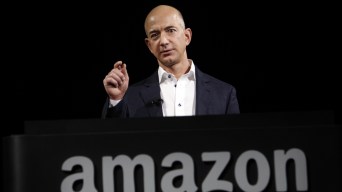
It’s June in Seattle, which means gray skies and clouds are the backdrop for a Wednesday morning when Amazon is expected to unveil its long-rumored smartphone. On Wednesday, Jeff Bezos is set to validate the whispers behind the badly-kept secret, something that hasn’t created this much buzz for the online retailer since its founder and CEO teased drone delivery service late last year.

In an event from the city’s Fremont Studios later today, Bezos will likely detail his company’s foray into the hotly-contested mobile handset market, a move that may possibly expand Amazon’s influence over consumers and further pit it against technology giants like Apple and Google. The presentation, which will not be broadcasted by Amazon, is set to kickoff at 10:30 a.m. PST, and will be followed from Seattle by Forbes in a liveblog below.
Read More.

New front in Amazon kerfuffle: Warner movies | Money.cnn.com

Amazon, has turned off the preorder function for DVDs of prominent Warner Bros. films as it seeks to raise pressure on the company during negotiations.”The Lego Movie,” for example, is listed as “currently unavailable” on Amazon. Set for release in the home video marketplace on June 17, there is no option to place a preorder.Warner is owned by Time Warner TWX, the parent company of CNNMoney.The missing preorder button illustrates the aggressive stance Amazon is taking in its negotiations with suppliers. Other retailers play hardball too — but Amazon’s gamesmanship is especially visible because it’s online.

Read More.

Why UPS Should Be Very Afraid of Amazon’s Delivery Plans | Entrepreneur.com

Amazon has already changed the way we shop and consume media. Who’s to say the ecommerce giant can’t also overhaul how you get your mail?

Amazon is testing out a pilot program in which its own fleet of drivers will bring Amazon packages to your door, completing the “last mile” of the delivery process, according to a report in today’s Wall Street Journal.

Amazon was not immediately available for comment.

The Seattle tech giant has been dropping hints for some time that it might develop its own delivery network. And it would be a smart place for the company to be looking for innovation: Amazon’s shipping costs have been consistently rising in recent years.

Read More.