Ford shifts truck production from Mexico to Ohio | Money CNN

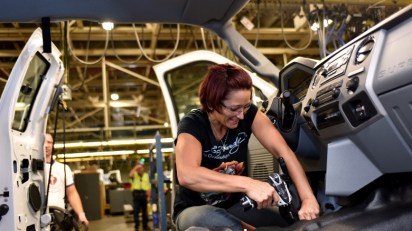
Ford’s heavy duty pickup trucks which used to be built in Mexico started rolling off an assembly line in Ohio this week.

That’s good news for the 1,000 Ford workers in Ohio, who might have otherwise been out of work.

It’s also good publicity for Ford (F), which has been under fire for investing so much in Mexico. In April, the automaker said it would invest $2.5 billion in transmission plants in the Mexican states of Chihuahua and Guanajuato, creating about 3,800 jobs there.

Ford’s south-of-the-border strategy has drawn heavy criticism from groups such as the United Auto Workers union and Republican presidential candidate Donald Trump.

The Avon Lake, Ohio, plant produced its first batch of Ford’s full-size F-650 and F-750 pick up trucks on Wednesday.


Read More.

Faking It at Work? Why You’re Better Off Being True to Yourself | Business News Daily

It may seem like you’re helping your career by being a team player and building relationships by faking interest in meetings, pretending to like a co-worker when you don’t or supporting ideas you’re not in favor of. However, new research shows that employees are hurting themselves when they’re not true to their beliefs.

Being inauthentic can make employees feel immoral, which in turn can lead to job unhappiness, frustration and burnout, according to a study recently published in the Psychological Science journal.

It’s important to not overlook the psychological distress that comes with inauthentic behavior, said Maryam Kouchaki, one of the study’s authors and a professor of management and organizations at Northwestern University’s Kellogg School of Management.

Read More.

Non-Profit Growth Strategies | Business Tips

downloadHere’s what we know. For profit companies develop a vision, strategic plan, execute it and grow.  So why shouldn’t non-profit organizations do the same? At CURE Childhood Cancer, our mission is to fund research that will lead to a cure for children’s cancer in which 16,000 new cases are diagnosed each year. So while we don’t manufacture or service gadgets, our approach for driving up revenue is built on the same business model as a for-profit company, and it works.  Over 9 years, we have grown 452% bringing passion and purpose to our goals of dispersing millions of dollars to medical research institutions and running innovative support programs to help patients and families facing the extraordinary challenges of childhood cancer.

Below are the primary ways we have embraced “entrepreneur-thinking” to exponentially grow our non-profit to the next level, getting closer to fulfilling our mission:

Read More.

Different by Deisgn | Peter Mehit

pictureIt’s the little things.  Shine your shoes.  Don’t chew gum.  Turn your phone off.

All of these small gestures show you’re serious.  The most basic elements of communicating your competence are spelling and grammar.  Grammar is becoming a little more fluid as pop culture references work their way into common usage.  On the other hand, spelling is binary.  It’s right, or it’s not.  Clearly, Preferred Kitchen And Bath is definitely different, either by the lack of ability to spell design, or by deisgn (pronounced ‛dees-in), which is a new school of design.

I think Newport Mesa owes them a deisgn refund.  Just sayin’…

  3 Ways to Get More Ideal Customers |  Getentrepreneurial.com

ideal-custIt costs too much to do business with some people.

Who are your “some people?”

How much time do they steal from your enjoyable customers? How much energy do you give them? How much attention that can be more profitably invested in your ideal customers relationships?

You’re throwing good time, energy, attention and therefore money after bad.

So why are you doing business with “some people?”

Select one of them. Just one. The most obnoxious of the bunch.

Here are 3 Ways to Get More Ideal Customers:

Read More.

Alphabet Lets Google Chase Moonshots and Stay Profitable | WIRED

GOOGLE IS NOW many Googles.

Company co-founder Larry Page said in a blog post Monday that Google is reorganizing into multiple companies that will sit under a new umbrella operation called Alphabet. Core businesses—Search, YouTube, and Android—will operate semi-separately from Google’s myriad “moonshots,” including the X lab and Page’s various life science projects.

Read More.

3 million gallons of toxic waste spilled by EPA is turning Colorado waters to orange sludge | Mashable

DENVER — The Environmental Protection Agency says the mine waste spill into Colorado waters is much larger than originally estimated.

The EPA now says 3 million gallons of wastewater spilled Wednesday and Thursday, instead of 1 million. The revision came after the EPA used a stream gauge from the U.S. Geological Survey. An EPA-supervised crew, who was trying to enter the mine to pump out and treat the water, caused the spill. The agency has not said how long cleanup efforts will take.

But an EPA official said Sunday that she doesn’t believe wildlife will suffer significant health impacts from the wastewater from an abandoned mine in southwestern Colorado.

Read More.

Seattle’s $15 An Hour: Measure The Unemployment Effects And There They Are | Forbes

downloadWe do keep being told this most delightful story: that raising the price of something isn’t going to change demand for that same thing that has just risen in price. This does rather contradict most of what we know about economics and the price system: demand curves do slope downwards after all.

True, there is one well known exception, what is called a Giffen Good (the definition of which is a good where the demand curve does not slope downwards). The only proven examples of this are wheat noodles in North China and rice in South China. But the general point is accepted that it probably applies to the subsistence carbohydrate in subsistence economies. People are living so close to the starvation line that when the price of the basic foodstuff goes up they have to cut their expenditures on other foods (possibly, little tasties or sauces to get that basic glop down) and increase their demand for that basic subsistence food in order to stay alive. They’re limited by the fact that they already live so close to the 2,000 or 3,000 calories a day needed to keep going. So, this might also apply to tortillas in the poorer parts of Mexico, or mealie meal in sub-Saharan Africa and so on.

Read More.

Five Things You Don’t Know About Millennials and Teens | Ypulse

Every month, we survey 1000 13-32-year-olds to learn about young consumers’ attitudes and behaviors, and today we’re using recent data to highlight five things that you probably don’t know about Millennials and teens, from their mobile behavior to their spending habits. Not everything you’ve read about them is true…

1. THEY’RE MORE TRADITIONAL THAN YOU THINK. 

Hookup culture and all those “newfangled” dating apps get a lot of attention, but in reality Millennials and teens are more traditional than you might think. 50% of 13-32-year-olds have been on a formal date, 25% are in a committed relationship, and 17% are married. The majority of those in a relationship met their significant other in an old-fashioned way: 32% met at school, 22% through mutual friends/family, 9% met at work. But how real is that infamous hookup culture? Only 23% of those over 18-years-old have had a one night stand. And while it’s true that sexting is a thing—34% have sexted, and 15% have “naughty Snapchatted”—the majority want stability in their romance, with 75% saying they want to be in a long-term committed relationship.

Read More.