
Dell Buys EMC For $67B In Largest Deal In Tech History | TechCrunch

In  the largest tech deal in history by far, Dell and partners MSD Partners and Silver Lake agreed to buy EMC today for $67 billion or $33.15 a share.

This is way over the $27 price being rumored last week, and makes the deal far larger than the $37 billion that Avago paid for Broadcom just last May. What makes this deal even more interesting is that Dell with a valuation of around $25 billion was by far the smaller fish at approximately half the size of EMC.

The biggest part of EMC by far is VMware, which was included in the deal and will continue to be a separately publicly traded company, but EMC will go private and become part of Dell ending the company’s long history as a publicly traded company.

The two combined companies will make the Dell and EMC the world’s largest privately controlled, integrated technology company, according to a statement released by EMC.

Read More

LinkedIn switching to ‘discretionary’ vacation policy | Cnn Money

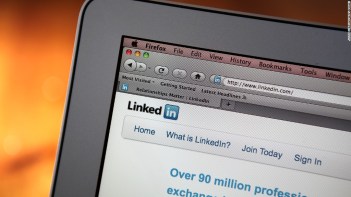
LinkedIn is the latest company to offer an open-ended time off policy to its employees.

The networking site is implementing a “discretionary time off,” or DTO policy, for its U.S.-based employees, LinkedIn (LNKD, Tech30) vice president Pat Wadors said in a blog post.

Starting November 1, the company will no longer offer a set number of days off each year. Instead, managers will work with employees to plan vacation time.

Under the new policy, LinkedIn employees will face “no set minimum or maximum amount of vacation time,” Wadors wrote.

“We are not alone in making this shift to DTO. It’s part of a growing movement to place more focus on results and empowerment, not hours worked,” Wadors wrote. “And it’s an important step to help employees recharge and keep engaged.”

The unlimited vacation model got its start at small tech firms, and a couple of major employers including Virgin (VA) and General Electric (GE) have adopted it over the past year.

The shift has caused bumps in some workplaces.

Read More

Texas university students to protest gun law with dildos | BBC News

Texas students are planning to hang sex toys from their bags in protest at a law allowing people to carry concealed weapons on university campuses.

“You’re carrying a gun to class? Yeah well I’m carrying a HUGE DILDO,” Jessica Jin, organizer of Campus (DILDO) Carry, wrote on Facebook.

About 3,000 people have signed up for the protest, which is planned for next year when the law takes effect.

Gun rights supporters have criticized the rally on the group’s Facebook page.

Texas Governor Greg Abbott enacted the campus carry law in June. Under the law, university presidents are permitted to create so-called “gun-free zones”.

“The State of Texas has decided that it is not at all obnoxious to allow deadly concealed weapons in classrooms, however it DOES have strict rules about free sexual expression, to protect your innocence,” wrote Ms Jin, a student at the University of Texas at Austin.

Read More

Solar & Wind Reach a Big Renewables Turning Point : BNEF | Bloomberg Business

Wind power is now the cheapest electricity to produce in both Germany and the U.K., even without government subsidies, according to a new analysis by Bloomberg New Energy Finance (BNEF). It’s the first time that threshold has been crossed by a G7 economy.

But that’s less interesting than what just happened in the U.S.

To appreciate what’s going on there, you need to understand the capacity factor. That’s the percentage of a power plant’s maximum potential that’s actually achieved over time.

Consider a solar project. The sun doesn’t shine at night and, even during the day, varies in brightness with the weather and the seasons. So a project that can crank out 100 megawatt hours of electricity during the sunniest part of the day might produce just 20 percent of that when averaged out over a year. That gives it a 20 percent capacity factor.

Read More

The Psychology of Social Proof in Email Marketing | The Startup Magazine

Social proof may be a popular marketing buzzword nowadays, but the concept extends way back in our evolutionary past. The ancestors of all primates existing today learned important survival skills by emulating and imitating each other, using mirror neurones. Our brains are still running on the same ‘monkey see, monkey do’ software as early humans. Whether it’s preventing us from going into an empty restaurant, compelling us to read product reviews before purchasing, or encouraging us to dump a bucket of ice water over ourselves  – social proof exerts a powerful influence on us.

Social proof can even be more motivating than a financial incentive. Consumers, like email marketers, are looking for a high ROI from their purchase. You can leverage social proof to win their trust and sell the added value of your product. But how should this be applied in an email campaign? Here are a few tips to steer you in the right direction.

Read More

12 Sure Signs You Shouldn’t Trust a Business Partner, Vendor | Small Biz Trends

When working with an outside company, there are only so many factors you can control. But based on their behavior, you should know when it’s time to back out.

That’s why we asked 12 entrepreneurs from Young Entrepreneur Council (YEC) the following question:

“What is one warning sign that a deal with a partner or vendor is not going to pan out?”

Here’s what YEC community members had to say:

1. There Are Long Wait Times Between Communications

“I find that when a partner or vendor takes a long time to respond to our calls or emails, it’s not going to work out.

Read More

Stupid Management Tricks – The Vanishing Fourth Floor | Los Angeles Times

When They Hit the Ceiling, These Execs Just Move to the Next Floor

June 21, 1999|ROY RIVENBURG
Quadrophobia Bureau: We’ve heard of buildings where the elevators don’t list a 13th floor. Now there seems to be a jinx on the fourth floor, as well. At the corporate headquarters of Hunt-Wesson Foods in Fullerton, for example, the entire fourth floor mysteriously vanished over Memorial Day weekend.

Apparently, company bigwigs decided that changing the number of the floor–which houses all the executive suites–would stop employees from referring to management as “the fourth floor” (as in “You won’t believe what the fourth floor did today” or “Naturally, the layoffs don’t affect the fourth floor”).

So presto, they turned it into the fifth floor. The elevators now stop at 1, 2, 3 and . . . 5, all room numbers on the floor no longer begin with a “4” and corporate directories were reprinted to eliminate any trace of the number that dare not speak its name.

We wanted to ask Hunt-Wesson if it also plans to refer to the Fourth of July as July 5, but we were told that the company’s lone spokeswoman was on the road (perhaps in her new five-wheel-drive sport utility vehicle) and unavailable for comment.

Meanwhile, employees have begun referring to management as “the fifth floor,” and the Beatles are now known as the Fab Five.

Lydia was a contractor of Hunt Wesson when this occurred.  She and her friend ran to the renumbered building.  ‘GTFO’, said Lydia’s friend as they read the numbers in the elevator: ‘1’, ‘2’, ‘3’, 5′.  – Ed

Urban Outfitters wants full-time employees to work for free | Business Insider

As the holiday season approaches, Urban Outfitters is hoping that its employees are in the giving spirit.

Gawker published an email asking the full-time employees at URBN, Urban Outfitters’ parent company based in Philadelphia, to work without pay during five weekend days in October.

The email explains that October is the busiest month of the year for URBN (which houses Urban Outfitters, Free People, and Anthropologie), and therefore, URBN needs its employees’ help.

Read More

What’s Your Most Productive Work Time? | Business News Daily

If you’re like many of today’s office workers, you begin your day between 8 and 9 a.m., end between 5 and 6 p.m., and spend the eight or nine hours in between juggling meetings, conference calls, emails and project deadlines — along with a few trips to the coffee maker to keep you alert and productive.

Sound familiar? If it does, then you probably also know that, despite your best efforts (and caffeine intake), you’re not always at your peak when you’re trudging through the daily stream of work. All 9-to-5ers go through productivity slumps during the workday, and yet they still try to power through and keep working, even if it means substandard output. But why do they do it?

Read More

What Your Flaky Behavior Is Really Telling People | Entrepreneur

There are certainly no shortage of reasons — or excuses — as to why you needed to cancel a meeting 30 minutes before it was scheduled, or why you were 20 minutes late for a call or appointment. I know what you’re thinking: “but I was super busy” or “my previous investor meeting went long.”

The reality is you’re going to be judged by your actions, and your actions are saying the wrong things.

Look, I’ve lived in the trenches of startup warfare — actually I’m in them right now while building two companies simultaneously — so I can both honestly and accurately say that I understand that things get crazy. But I must also say that it’s incredibly important to effectively manage your time and schedule, at least if you don’t want to burn dozens of bridges through your journey, which will only make things more difficult in both the short and long runs.

Read More