No One Works When It’s Hot, So Climate Change Is Going To Ruin The Economy | Fast Company

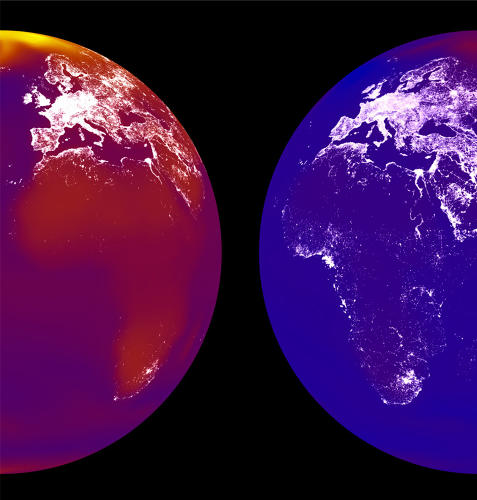
3052676-slide-s-3b-rich-countries-wont-escape-the-terrifyingThe slowing down of life on a hot summer day isn’t your imagination. Economic literature is full with examples of how productivity comes to a crawl—even in America’s over-air conditioned society—when the temperatures climb above a given tipping point.

Consider that the number of cars rolling off U.S. auto assembly lines decreases during heat waves. Or that American children have scored lower on math tests that are given when the thermometer rises above 79 degrees. One study found that weekdays above 86 degrees have cost an average of $20 a person in lost economic performance in the U.S. And if temperatures above 85 degrees are sustained over a growing season, yields for crucial crops like corn and soybean in the U.S. drop substantially—a worrisome economic and global food security outcome in a predicted future of hotter summers.

The many trillion dollar question is what happens when all of these individual effects become more frequent as the world’s thermostat rises. How much will climate change cost? And how will it change the economic landscape of the places that aren’t affected by heat-related productivity losses now, but will be soon.

Read More

How Can Marketers Be Certain Their Mobile Ads Are Actually Getting Seen? | Adweek

Having addressed marketers’ concerns about desktop viewability (ads that are actually seen by consumers) in 2014, the Media Rating Council is now in the hot seat to provide guidance on mobile advertising.

In May, the MRC made its first statement on mobile viewability, saying that smartphone-size ads need to be measured differently than desktop ads. Five months later, however, marketers are still waiting for an industry standard for chargeable impressions to buy ads against, even with the MRC’s promise to address the issue by the end of the year.

“Mobile viewability is huge—people want it done already, so there is a lot of pressure on all sides to move this forward,” said George Ivie, CEO and executive director of the MRC. “There’s also pressure to do it right. We don’t want to set parameters that aren’t properly informed by the data and how people use mobile.”

Read More

Protect Your Small Business Against Credit Card Fraud | BusinessTips.com

downloadYou’ve probably heard of people stealing, buying and selling credit card information.  You don’t want your business to be the victim of such a transaction. But on any given day, your small business is now vulnerable.

The cardholder’s issuing bank previously took care of these situations.  Previously.

That’s the way it used to be.  Now your small business could be the one that is liable–not the issuer.  Starting October 1, the rules changed for Europa, MasterCard and VISA (EMV) cards.  Now, there are “chip cards”, and U.S. credit card companies set October as the deadline for the national adoption of their new chip cards.  So, if you have not integrated EMV technology that processes chip cards, your business will now become financially responsible for fraudulent transactions previously covered by the cardholder’s issuing bank.

Read More

Tesla gets approval for global Autopilot rollout | Mashable

Tesla’s Autopilot set of features — the one that basically let your Tesla drive itself (though you should still keep your hands on the steering wheel) — was initially only approved in the U.S., but now it’s ready to roll out globally.

Company CEO Elon Musk said as much in a tweet Saturday, claiming Tesla has received regulatory approvals to launch Autopilot in “all countries” except Japan, which is “under review.”

A $2,500 upgrade for owners whose Tesla was built after September 2014, Autopilot has several features that improve the car’s autonomy on the road. These include letting the car steer itself on the freeway, automatic lane changing and overtaking slower vehicles and automatic parking.

The features received a warm welcome from the media (read our review here), but Tesla hasn’t been resting on its laurels. In another tweet Saturday, Musk promised several new features in an upcoming version of Autopilot: “curve speed adapftion, controller smoothness, better lane holding on poor roads, improved fleet learning”.

Read More

Here’s What Really Happened at That Company That Set a $70,000 Minimum Wage | Inc.com

Before Dan Price caused a media firestorm by establishing a $70,000 minimum wage at his Seattle company, Gravity Payments… before Hollywood agents, reality-show producers, and book publishers began throwing elbows for a piece of the hip, 31-year-old entrepreneur with the shoulder-length hair and Brad Pitt looks… before Rush Limbaugh called him a socialist and Harvard Business School professors asked to study his radical experiment in paying workers… an entry-level Gravity employee named Jason Haley got really pissed off at him.

It was late 2011. Haley was a 32-year-old phone tech earning about $35,000 a year, and he was in a sour mood. Price had noticed it, and when he spotted Haley outside on a smoking break, he approached. “Seems like something’s bothering you,” he said. “What’s on your mind?”

“You’re ripping me off,” Haley told him.

Read More

YouTube Will Completely Remove Videos Of Creators Who Don’t Sign Its Red Subscription Deal | TechCrunch

YouTube made its top video creators an offer they literally couldn’t refuse, or they’d have their content disappear. Today YouTube confirmed that any “partner” creator who earns a cut of ad revenue but doesn’t agree to sign its revenue share deal for its new YouTube Red $9.99 ad-free subscription will have their videos hidden from public view on both the ad-supported and ad-free tiers. That includes videos by popular comedians, musicians, game commentators, and DIY instructors, though not the average person that uploads clips.

It’s a tough pill to swallow that makes YouTube look like a bully. Though turning existing fans into paid subscribers instead of free viewers could earn creators more than the ad revenue, forcing them into the deal seems heavy-handed.

Google says the goal is to offer consistency, so people thinking about subscribing to Red don’t have to worry about their favorite content not being available in the ad-free service. But there’s no explanation why it couldn’t just flag videos of those who don’t sign the deal as “Not On Red”, and instead had to go with a sign-or-disappear strategy.

Read More

Forget Raises. Employers Lean on Health Benefits to Retain Workers | Bloomberg Business

Wages are still stagnant, yet employers have found something else to help attract and retain employees: health-care benefits. A good insurance plan has become a more vital tool than ever for hiring, according to a recent survey from the Society of Human Resources.

In general, the study found, companies are leaning on benefits to woo current and potential employees. Of the 460 human resources professionals in the survey, 33 percent said that in the last year their organizations used benefits of some kind—ranging from paid leave to wellness programs—to keep employees at all levels from leaving the company. That marks a surge from just 18 percent who relied on benefits to retain staff in 2012.

Read More

Alabama judge orders defendants to give blood to avoid jail | BBC News

An Alabama judge encouraged defendants who could not pay court fines to donate blood rather than spending time in jail, a US civil rights group has said.

“If you do not have any money and you don’t want to go to jail, consider giving blood today,” Judge Marvin Wiggins said in a recording released by the Southern Poverty Law Center (SPLC).

Some of the 500 defendants gave blood to avoid jail, but their debt remained.

The practice violates the US Constitution, legal experts said.

Judge Wiggins declined to comment on the allegations when contacted by the New York Times.

“Far too often in Alabama, we find that your legal rights are tied to your bank account,” Sara Zampierin, a staff attorney in SPLC’s Montgomery, Alabama, office said in a statement on Tuesday.

Read More