Amazon’s Agentic AI: Empowering Robots to Understand and Act on Human Commands | Cool Business Ideas

Amazon is pioneering a future where warehouse robots like Proteus can comprehend and execute spoken instructions. The company’s new Agentic AI team is developing an AI foundation model framework designed to revolutionize robotic operations, enabling machines to understand natural language, reason, and act autonomously.

Impact:

This innovation signifies a transformative shift in human-robot interaction within Amazon’s operations. By allowing robots to process and act upon verbal commands, the technology aims to enhance efficiency and safety in warehouses. Additionally, Amazon introduced “Wellspring,” a generative AI initiative to improve last-mile delivery precision and driver experience, and unveiled the latest AI foundation model for its Supply Chain Optimization Technology (SCOT), which processes over 400 million items across 270 time spans. These advancements collectively promise to streamline operations, reduce costs, and improve customer satisfaction.

Read More

Where are all the robots? | TechCrunch

We were promised robots everywhere — fully autonomous robots that will drive our cars end-to-end, clean our dishes, drive our freight, make our food, pipette and do our lab work, write our legal documents, mow the lawn, balance our books and even clean our houses.

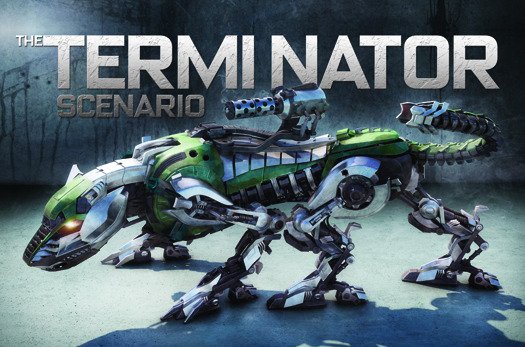
And yet instead of Terminator or WALL-E or HAL 9000 or R2-D2, all we got is Facebook serving us ads we don’t want to click on, Netflix recommending us another movie that we probably shouldn’t stay up to watch, and iRobot’s Roomba.

So what went wrong? Where are all the robots?

Read More

Tax the Rich and the Robots? California’s Thinking About It | WIRED

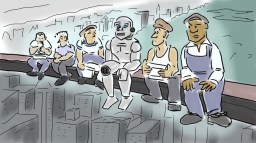
DEPENDING ON WHOM you ask, robots and artificial intelligence are either coming to take your job, or you’re perfectly safe, at least for the near future. Truth is, automation always has and always will put people out of work. It’s just that this time around, even highly skilled jobs may be imperiled. And that has some folks dreading a time in which robots and AI upend the human workforce.

Included among those folks is San Francisco supervisor Jane Kim, who Wednesday launched a campaign called the Jobs of the Future Fund to study a statewide “payroll” tax on job-stealing machines. Proceeds from the tax would bankroll things like job retraining, free community college, or perhaps a universal basic income―countermeasures Kim thinks might make a robotic future more bearable for humans.

Read More

Japan Unleashes A Robot Revolution | Bloomberg Business

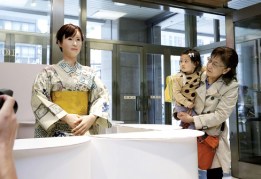
A new greeter at the entrance of the Mitsukoshi department store in central Tokyo has caused a stir. The worker, dressed in a kimono and cheerfully welcoming shoppers in honorific Japanese, is a robot made by Toshiba and shows how lifelike these machines can be.

This latest example of Japan’s skill comes just as Prime Minister Shinzo Abe is calling for a “robot revolution.” Advances in robotic computing power, the ability to recognize voices and images, and machine learning could help the country overcome the handicap of a fast-aging populace and a declining workforce.

At the opening of Japan’s Robot Revolution Initiative Council on May 15, Abe urged companies to “spread the use of robotics from large-scale factories to every corner of our economy and society.” Backed by 200 companies and universities, the five-year, government-led push aims to deepen the use of intelligent machines in manufacturing, supply chains, construction, and health care, while expanding robotics sales from 600 billion yen ($4.9 billion) annually to 2.4 trillion yen by 2020.

Read More.

9 jobs robots could replace in 2015 | Mashable

Walking through the city, I find myself thinking about all the jobs a robot could do.

A robot could probably stand in for my coffee truck guy, though I doubt he’d smile, call me “buddy” and ask if I said “three sugars” or “no sugar.”

A robot could probably take over for that guy spraying down the street every morning — though I often wonder why we need anyone doing that at all.

Could a robot drive that taxi, which just deposited a woman on Fifth Ave.? Probably, though I bet it wouldn’t be as good at multi-tasking. I’ve watched taxi drivers snack, take a call and quiz me about my work all while driving above the speed limit. A robot might simply drive at 25 MPH.

These are not idle thoughts. In two separate reports over the last two years, researchers predicted that the rise of the robot worker was imminent. In the UK, Deloitte and the University of Oxford predict that 10 million unskilled jobs could be taken over by robots. Last year, Oxford Research predicted that 45% of the U.S. jobs across a fairly wide spectrum of industries could be automated and taken over by computers by 2033.

Read More.