THIS WEEK’S HEADLINES:
- June U.S. Employment Report
- U.S. Light Vehicle Sales in June
- Events of Interest
- July 17, 2013: LAEDC Mid-year Economic Forecast: The Future of Energy in the Southland


Below is the transcript of the full interview I conducted with Dr. Richard Sudek, Director of Chapman University’s Leatherby Center for Entrepreneurship and Business Ethics. The center is nationally recognized as a leader in the field and Chapman has produced a number of notable entrepreneurs, including our client, Frank Delgadillo, creator of the Ambiguous and Comune action wear lines.
Excerpts from this interview appeared in Impact (formerly Caypen) magazine in both their online and print editions.
Q: Can you give us some background on the Leatherby Center and what you do here?
Sudek: I’m the Director of the Leatherby Center for Entrepreneurship and Business Ethics.
PM: What is your background?
Sudek: I had my own computer company, built starting with $250 and sold it, so I’m not your typical academic. What I’m really trying to do is change the entrepreneurial ecosystem here in OrangeCounty. The entrepreneurial ecosystem is poorly connected from my perception. We’d like Chapman to be involved in helping connect it. We’d like Chapman to be the place where entrepreneurs, inventors and investors meet and collaborate.
Most of our energy is outward facing rather inward facing.
One of the things to point out is that Chapman one of the best kept secrets here in OrangeCounty. We’re a top 50 business school. We have a Nobel prize winner in economics. Our entrepreneurship program is ranked 13th by BusinessWeek. Because I wanted to cross connect the university, we built this thing called ESUN, Entrepreneur Student University Network. Originally it was designed to be small, so we started with the local schools; Cal Tech. USC, UCLA, Loyola, Pepperdyne, UCI, Fullerton and Claremont McKenna to try to cross connect our centers which we’re starting to do.
The thing that really launched this is we created this competition called California Dreaming. And we brought in other schools such as Oklahoma, BYU, Berkeley and Hawaii, etc and created a $100,000 business plan competition that we have in April. Next year it will be a $200,000. It’s going actually be two different competitions a business plan competition and fast pitch competition. Microsemi will be the anchor sponsor, as they were last year. The idea is to get students in front of investors, not just to win cash. I brought in VCs and angels from the bay area and local VCs and angels.
One of the teams, BYU, who won the competition, got some equity funding from this in late April. So that’s the idea is to get students connected to that.
PM: So you’re trying to build the hub for this kind of activity here?
Sudek: Yes. Now this reaches outward across different states so the idea is the help students in general although focused on Chapman, OrangeCounty, Southern California, going out from there.
Continue reading “Dr. Richard Sudek Interview | Peter Mehit”

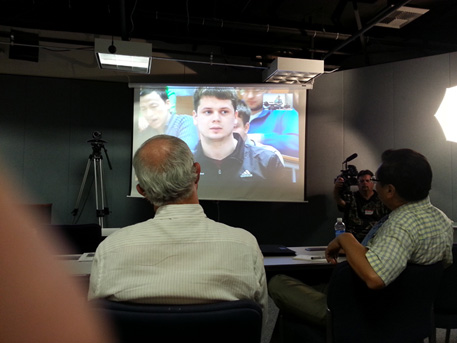
Last Friday, we had the honor to speak with a room full of entrepreneurs in Surgut, Siberia via teleconference. The conference was set up by Michelle Skiljian of the Inland Empire Women’s Center and Dr. Tapie Rhom, an IT professor at CSUSB along with the help of many others. We filed into the tele-learning center at Cal State San Bernardino for a 7:00pm start. The tele bridge started late because the participants on the Russian end had to fight a snow storm to get to the venue. The crowd was slow to build but after about twenty minutes there were fifty or so participants involved in the conversation with about 15 Southern California business owners.
They aren’t all that different than us, except they have higher expectations for what America does for it’s start up nation. Most of their questions centered on sources of capital (with an interesting sidebar about support for parolees), the kinds of businesses we start here and, in particular, the kinds of businesses women are getting into. The Russian audience was majority women and the only three business owners that spoke were women. They explained the split of business owners in Russia 85-15% male, with the majority of women owning care giving or service businesses.
Continue reading “Speaking With Russian Entrepreneurs | Peter Mehit”
THIS WEEk:

In December, my wife, Elaine, and I attended a 50th-anniversary concert of the Rolling Stones at Brooklyn, New York’s new Barclays Center. They’re often referred to as the Strolling Bones these days, and with good reason. They’re old. You can’t help noticing how weathered their faces look. So it’s all the more amazing to watch Mick Jagger, at 69, strutting around the stage just like he did half a century ago. I couldn’t take my eyes off him. He and I are about the same age. “Why is he doing this?” I asked myself. “He doesn’t need the money. What is it?”
Then it hit me. I dropped down into my seat and started to laugh. “Why are you laughing?” Elaine shouted over the din. “I just figured out what’s been driving me all these years,” I shouted back.
As I told her later, I’d had an epiphany. I’d suddenly understood the meaning of the word passion. Mick Jagger, I realized, keeps doing what he does for the same reason that I keep doing what I do: because he has to. Performing defines him. He has to do it in order to feel alive–which is also why I start and build businesses.
 Compared to the last boom/bust technology cycle that culminated with the dot com crash of 2000, the social-era combatants are in an even more precarious position. Back then, the engine of the expansion was e-commerce, which at least generated revenue (although clearly not at ROI sufficient to save Pets.com, Webvan.com, Boo.com and legions of other online ghosts). Last time, success and failure was driven as much by expense control as revenue generation, and the huge influx of public market financing through IPOs allowed start-up companies to essentially trade dollars back and forth in a giant shell game.

 Dispatches From The Front