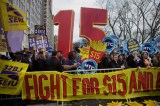
 As the proposed federal minimum wage goes up and up, economists support it less and less. In January 2014, seven Nobel laureates and eight ex-presidents of the American Economic Association signed a letter backing a federal minimum wage of $10.10 an hour by 2016, up from $7.25. They said it would “provide a much-needed boost” to low-income workers while causing “little or no” job loss. Fifteen dollars an hour is another story. None of those luminaries signed the letter in July that endorsed a Senate bill introduced by presidential candidate Bernie Sanders (D-Vt.) to raise the federal minimum to $15 an hour by 2020.
Regional economic differences are one reason a lot of economists are nervous about jumping to $15: A wage floor that’s right for New York or San Francisco could be too high for Brownsville, Texas; Gadsden, Ala.; or Ponce, Puerto Rico. In such places, $15 an hour “may have large negative employment effects,” Ronald Ehrenberg, a Cornell University labor economist, wrote in an e-mail. He was one of about 600 economists who signed the $10.10 letter last year. He says he wasn’t approached to sign the $15 letter but would have said no if asked.



 Dispatches From The Front