With the recession forcing more and more Americans to burden their credit cards with debt, it’s time to ask whether the increasing accrued costs are manageable, or are detrimentally impacting lives.
“…Powerful people at the heart of our financial system still have the incentive and ability to take on large amounts of reckless risk – through borrowing large amounts relative to their equity.
There is an insularity and arrogance to policymakers around capital requirements that is distinctly reminiscent of the Treasury-Fed-Wall Street consensus regarding derivatives in the late 1990s – i.e., officials are so convinced by the arguments of big banks that they dismiss out of hand any attempt to even open a serious debate.
Next time, when our largest banks get into trouble, they may be beyond “too big to fail”. As seen recently in Ireland, banks that are very big relative to an economy can become “too big to save” …
…what the Bank of England refers to as a doom loop“.
The Small Business Advocate is a periodic newsletter that details economic developments and regulatory trends related to small business as well as the latest initiatives of the Small Business Administration’s Office of Advocacy.
In This Issue
Executive Order 13563 to Improve Regulatory Review, 1
Text of E.O. 13563, 6-7
OSHA Withdraws Two Rules, 1
Startup America Launched, 2
Rodgers Appointed Deputy Chief Counsel, 11
New Advocacy Staff, 11
Message from the Chief Counsel
Small Business Talks; Advocacy Listens, 3
Research Notes
Small Business Economy Released, 2
Legislative Focus
Freshmen Senators Schooled in Small Business Values, 4
‘You can take the blue pill and wake up in your bed and believe whatever you want. Or you can take the red pill and see how far down the rabbit hole goes…’ That line from ‘The Matrix’ applies to this piece by Giordano Bruno. If you’re having a tough time wondering how the stock market can go up while people are losing jobs and homes, this will give you something to hang your hat on.
WARNING: You can’t unlearn this information.
This may be a highly distasteful proposition, but just for a moment, I want you to sit back, and imagine that you are a member of the corporate banking elite. You are a walking talking disease ridden power mad pustule who naively believes himself intellectually superior to the vast majority of humanity and above the inherent laws of conscience, honor, and general good taste. You are a villain in the purest sense, in that you not only do great harm to the world, you actually SEEK to do great harm to the world, if only to benefit yourself and your exclusive circle of “friends”; a clan of degenerate blood thirsty sociopaths with delusions of omnipotence that stalk the night like Armani wearing Chupacabra exsanguinating the joy from poor unsuspecting cultures. You are capable of anything, and sadly, you take “pride” in this fact…
…the justice system not only sucks at punishing financial criminals, it has actually evolved into a highly effective mechanism for protecting financial criminals. This institutional reality has absolutely nothing to do with politics or ideology — it takes place no matter who’s in office or which party’s in power. To understand how the machinery functions, you have to start back at least a decade ago, as case after case of financial malfeasance was pursued too slowly or not at all, fumbled by a government bureaucracy that too often is on a first-name basis with its targets. Indeed, the shocking pattern of nonenforcement with regard to Wall Street is so deeply ingrained in Washington that it raises a profound and difficult question about the very nature of our society: whether we have created a class of people whose misdeeds are no longer perceived as crimes, almost no matter what those misdeeds are.
The result: At least for the moment, the contents of Wells Fargo Home Mortgage, 1341 N. Delaware Ave., are scheduled for sheriff’s sale on March 4 to satisfy the judgment and pay about $200 for court and sheriff’s costs.
The major kink in the housing market’s recovery, and for the macro economy overall, is the work left to be done on homes currently in the foreclosure process, those about to enter it and the amount of repossessed homes the banks must shed. Striking a proper balance on how to mange this shadow inventory of foreclosures is vital for the banks to show a healthy balance sheet while not dumping too many distressed properties onto the market, further dragging down home prices and values.
Not only did Capital One ignore the demand, under Pennsylvania’s version of the FDCPA, that all future communications be with Perry’s lawyer, continuing to make phone calls to her home, her office, and even some of her friends and relatives, but it kept arbitrarily changing the alleged amount due. Finally, Perry received a letter demanding payment of $286,651,237.00.
On Thursday, when they spoke, the bank executive was sweetness and light—she told them that Ilsa and Brian qualified for HAMP, that they would get refinanced, that they would not have to pay the difference in mortgage of the last three months—“Your lower mortgage rate is locked in!”
And as to the $84 penalty fee, which had driven Brian in particular up the wall: It was waived.
Ilsa told me, “It was the nicest conversation we’ve ever had with a bank executive.”
The executive promised to have the papers drawn up, ready to be signed before November 1.
That’s right: November first. After dicking them around for months on end, Wells Fargo all of a sudden went from turtle-speed to light-speed—to warp-speed—boom!—just like that. They didn’t even engage thrusters, Captain—it was warp drive the instant Brian e-mailed that threat.

 ‘You can take the blue pill and wake up in your bed and believe whatever you want. Or you can take the red pill and see how far down the rabbit hole goes…’ That line from ‘The Matrix’ applies to this piece by Giordano Bruno. If you’re having a tough time wondering how the stock market can go up while people are losing jobs and homes, this will give you something to hang your hat on.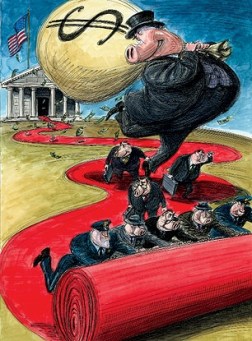
 A folk hero in the making!
The major kink in the housing market’s recovery, and for the macro economy overall, is the work left to be done on homes currently in the foreclosure process, those about to enter it and the amount of repossessed homes the banks must shed. Striking a proper balance on how to mange this shadow inventory of foreclosures is vital for the banks to show a healthy balance sheet while not dumping too many distressed properties onto the market, further dragging down home prices and values.



 Dispatches From The Front
