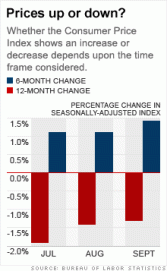
The government says consumers are paying less for their everyday needs compared to a year ago. But if it feels like your dollar is not going as far as it used to, you’re not alone.
The government says consumers are paying less for their everyday needs compared to a year ago. But if it feels like your dollar is not going as far as it used to, you’re not alone.
THE INVISIBL E HAND OF THE MARKET MOVES UPON THE WATERS…
This is a classic example of why capitalism will never go away. It’s efficient and it rewards initiative. A pirate leader, what you might call a ‘vulture capitalist’, describes the market:
“The shares are open to all and everybody can take part, whether personally at sea or on land by providing cash, weapons or useful materials … we’ve made piracy a community activity.”
And just like any capital market, shareholders wait breathlessly for returns:
Piracy investor Sahra Ibrahim, a 22-year-old divorcee, was lined up with others waiting for her cut of a ransom pay-out after one of the gangs freed a Spanish tuna fishing vessel.
“I am waiting for my share after I contributed a rocket-propelled grenade for the operation,” she said, adding that she got the weapon from her ex-husband in alimony.
“I am really happy and lucky. I have made $75,000 in only 38 days since I joined the ‘company’.”
Two questions: I wonder what Adam Smith would think? And, when is Merrill Lynch going to start offering pirate funds?
Warning: Some may require Dramamine before reading this article. This is a cafeteria, by the way. Imagine keeping your food down in this environment.

You have got to see these photos. NOTICE: May cause vertigo..
 Senator Jim Bunning smokes Ben Bernanke:
Instead of taking that money and lending to consumers and cleaning up their balance sheets, the banks started to pocket record profits and pay out billions of dollars in bonuses. Because you bowed to pressure from the banks and refused to resolve them or force them to clean up their balance sheets and clean out the management, you have created zombie banks that are only enriching their traders and executives.
…you put the printing presses into overdrive to fund the government’s spending and hand out cheap money to your masters on Wall Street, which they use to rake in record profits while ordinary Americans and small businesses can’t even get loans for their everyday needs.
A more complete, yet less satisfying description of the hearing can be read here.

Since the 1930s, more than 30 patents have been filed for flying car designs, documenting the dreams of dozens of aviation entrepreneurs enthralled by Jetsonian ideals of zooming around dodging traffic in tiny, efficient personal aircrafts.
Yet the history of small Internet companies being snapped up by large ones isn’t pretty. Just in the past few months, eBay has had to unload both StumbleUpon (the Web recommendations engine it bought in 2007 for $75 million) as well as the Internet-phone service Skype (purchased in 2005 for $3.1 billion), each for a loss. Yahoo is looking to rid itself of several properties, including Zimbra, the email company it snapped up in 2007 for $350 million. FeedBurner, Jaiku, and Dodgeball are only a few of the startups languishing in obscurity under the Googleplex.
The Office of the Small Business Advocate has this news:
Continue reading “Stimulus News Digest #10 – November 2009 | California Office of the Small Business Advocate”

The government has been backing up to the back doors of these institutions, unloading truckloads of cash. Many have used the funds to purchase other banks or shore up their balance sheets; few have passed any relief to their customers. The backlash against them has primarily been debt repudiation (bankruptcy and foreclosure) and now, debt cancellation.
Spinner excoriated OneWest for repeatedly refusing to work out a deal, for misleading him about the dollar amounts at stake in the case, and for its treatment of the couple over months of hearings.
OneWest’s conduct was “inequitable, unconscionable, vexatious and opprobrious,” Spinner wrote.
He canceled the debt because the bank “must be appropriately sanctioned so as to deter it from imposing further mortifying abuse against [the couple].”
The bank is involved in a similar case in California, where it’s trying to foreclose on an 89-year-old woman, despite two court orders telling it to stop.

The very thing that the former endowment chiefs had worried about and warned of for so long then came to pass. Amid plunging global markets, Harvard would lose not only 27 percent of its $37 billion endowment in 2008, but $1.8 billion of the general operating cash – or 27 percent of some $6 billion invested. Harvard also would pay $500 million to get out of the interest-rate swaps Summers had entered into, which imploded when rates fell instead of rising. The university would have to issue $1.5 billion in bonds to shore up its cash position, on top of another $1 billion debt sale. And there were layoffs, pay freezes, and deep, university-wide budget cuts.
 This is mainly an experimentation with soft bodies using toxi’s verlet springs.
The data refers to the evolution of the top 4 maritime empires of the XIX and XX centuries by extent. The visual emphasis is on their decline.

