7 Tips to Get the Most Out of Your Job Listings | All Business

Looking to hire sometime soon? If you want to make your job listing stand out on job boards and attract the top talent, you’ll want to read these seven tips on making the most of your job posting.

1. Have a Clear Job Title

According to Kevin Walker, Indeed.com’s Director of Employer Insights, a well-crafted job title can increase traffic to your listing by up to 1000%! So what exactly does a clear job title look like and what do you need to do to make sure your listing has one?

Make the Title as Specific as Possible – For example, “Guest Content Editor” is much more descriptive than “Editor 2”

Read More

7 Things Your Parents Never Taught You about Being an Adult | Page19

Your twenties and early thirties are an exciting time. You’re blazing a trail in your first career, learning what you’re really amazing at and where you might need some work, experiencing loves that have potential to last, and maybe even thinking about buying a house. All of this stuff is big—after all, you’re building a foundation for the rest of your adult life—and its collective approach can make you feel like a tiny island nation preparing for a tsunami.

So how do you prepare yourself for what’s to come, weather-proof your basement floor and build for both sunny and inclement weather?

We’ve whipped up a handy little guide with 7 practical tips from some of the best books for people who are newly navigating the world of adults. Here, learn why you shouldn’t depend on a savings account to rescue your retirement, when’s the right time to invest in property, and the single most important thing amazing employees do when they’re young.

Read More

Google and Microsoft agree to lawsuit truce | BBC News

Microsoft and Google have agreed to end a five-year battle over patents.

Eighteen lawsuits had been active between the companies, relating to uses of technologies in mobile phones, wifi and other areas.

Details of the deal were not shared, but in a joint statement the firms said they would “collaborate on certain patent matters”.

It is the latest move by technology firms to keep patent rows out of the courts.

The battles, particularly over software, intensified in recent years as firms sought to capitalise on their patent portfolios.

But of late there has been a shift towards licensing rather than litigation.

Read More

What Turning 35 Taught Me About Money | The Simple Dollar

A debt-free life is better than the alternative.

For the first few years of our marriage, my husband and I didn’t pay too much attention to our spending or our outstanding debts. We made decent incomes, after all, and didn’t have any children. What difference did it make if we carried credit card debt, student loans, or car loans?

Here’s what I found out — it makes a huge difference. With two kids in school now and the college years fast approaching, I can’t imagine how unstable I would feel if we carried the kind of debt we did early on.

Now that I know a debt-free life is much better (and a lot less stressful) than the alternative, my plan is to avoid debt like the plague if at all possible. For us, that means driving older cars, saving money for splurges so we can pay in cash, and staying put in our reasonable home. If that keeps us debt-free, that’s fine with me.

Read More

AI Is About To Go Mainstream And Reshape The Workplace | TechCrunch

Much like the evolution of systems design, IT-enabled process change ebbs and flows over time. We see this in history as each technology revolution brings with it a refactoring of business operations.

With the rise of client/server computing in the 1980s, and the introduction of database servers and visual development tools like PowerBuilder, “business process re-engineering” became all the craze during the 1990s.

By 1993, 60 percent of the Fortune 500 developed IT systems to automate mundane tasks like insurance claims processing or AP invoice/purchase order reconciliation, channeling the mandate of technology-led business transformation in Michael Hammer’s infamous 1990 HBR article, “Don’t Automate, Obliterate.”

Twenty-odd years later, we’re about to see another “flow” of transformation thanks to resurgent interest in artificial intelligence and the emergence of the AI-powered business application. What’s different this time around is the transformation will be driven bottom up by rank-and-file employees, making it potentially more disruptive than any “flow” of process change that came before. What are AI-powered apps, and what do they have to do with business process re-engineering?

Read More

The Fake Traffic Schemes That Are Rotting the Internet | Bloomberg Business

Ron Amram has been in the brand marketing business for about 20 years. In the 2000s he was media director for Sprint’s prepaid cellular group, mainly figuring out where the carrier should spend its ad dollars—print, outdoor, digital, or broadcast. TV was always at the top of the pyramid. A TV campaign was like “the Air Force,” Amram says. “You wanted to get your message out, you did carpet bombing.” But TV wasn’t cheap, nor did it solve “that age-old question: Half of my marketing is working, half of it is not, and I don’t know which half.”

About 10 years ago, not long after Google went public and Yahoo! was still worth upward of $50 billion, attitudes shifted. Digital search and display ads had the potential to reach TV-size audiences at a fraction of the price. “People thought it was going to change everything,” Amram says.

The euphoria escalated again around 2010 with the arrival of programmatic advertising, a typically banal industry term for what is, essentially, automation. The ideal programmatic transaction works like this: A user clicks on a website and suddenly her Internet address and browsing history are packaged and whisked off to an auction site, where software, on behalf of advertisers, scrutinizes her profile (or an anonymized version of it) and determines whether to bid to place an ad next to that article. Ford Motor could pay to put its ads on websites for car buffs, or, with the help of cookies, track car buffs wherever they may be online. Ford might want to target males age 25-40 for pickup-truck ads, or, better yet, anybody in that age group who’s even read about pickups in the past six months.

Read More

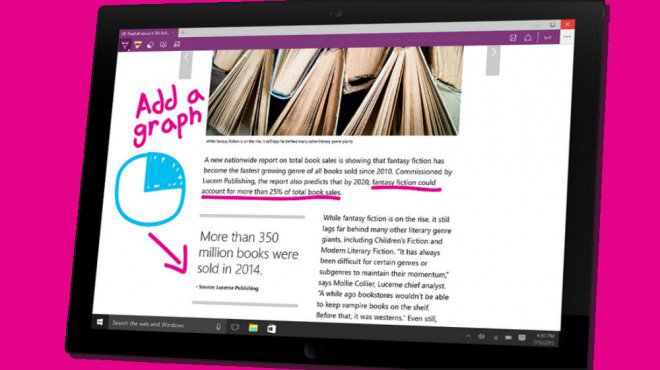
Could Microsoft Edge Be Your New Web Browser? | Small Biz Trends

edge-browser-660x370To date, one of the biggest standouts in Windows 10 is the new Microsoft Edge browser.

For many, it’s just a relief to say goodbye to Internet Explorer once and for all. (You won’t have Internet Explorer to kick around anymore.)

After 20 years, many innovations and a long period of stagnation, it took a lot to overhaul this browser.

Jacob Rossi, a senior engineer on Microsoft’s Web platform team, says:

“We’ve fixed over 3,000 interoperability issues (some dating back to code written in the 90s) on top of the over 40 new Web standards we’re working on. For example, longstanding inner HTML issues are now fixed.”

So, is the new Microsoft Edge browser really all that much different than its predecessor? Let’s take a look at some of the early returns on the new Edge browser.

Of course, one of the best places to look for instant reactions is on Twitter. And there, — surprisingly — you’ll find a lot of praise for one of the more hyped additions to the new Windows 10 operating system.

Read More

Meet 3 angry Volkswagen owners | CNN Money

Volkswagen’s costly lie has left the giant automaker in crisis. It has also left its customers feeling confused, cheated and steaming mad.

The emissions scandal affects nearly 500,000 diesel Volkswagen and Audi cars in the U.S. alone — and millions more around the world. The scandal came to light when the EPA said Volkswagen had cheated on smog tests.

U.S. regulators have ordered the company to recall the cars at issue. But VW hasn’t done that yet, nor has it said how it will get the cars to comply with the law or how it will compensate customers.

Bottom line: Who knows what comes next? CNNMoney has heard from many Volkswagen customers in recent days. Here are some of their stories.

Read More

Bright Angel Within | Peter Mehit

imagesIt doesn’t matter the time of day; the view from Bright Angel point on the Grand Canyon’s north rim is breathtaking. From rust, to red, to pink and metallic green, the weathered rock presents history itself at the boundary of each color. Millions of years laid bare for the eye to see, for the mind to imagine, the timelessness of the earth. The insignificance and interconnectedness of a single person is instantly apparent.

I’ve had this same experience walking the streets of New York among the massive buildings and crowded streets. The insane energy of that place, always in motion, penetrates my psyche. In both places I am awake and connected. I hear everything clearly. My eyes are open and receiving. Most importantly, my mind is quiet.

That is what inspiration is. It is simultaneous connection from deep within our selves to the world that makes us awake and aware. When we are inspired, we are present and invested this moment, the only place we actually live. This connection shuts down the nearly non-stop self talk we engage in. It opens us up to messages from our environment and the thoughts of others. That is why inspiration is so important, because it gives us a way to get outside of our own boundaries, if only for an instant.

Continue reading “Bright Angel Within | Peter Mehit” →