The Anarchist Soccer Mom: Thinking the Unthinkable

I am sharing this story because I am Adam Lanza’s mother. I am Dylan Klebold’s and Eric Harris’s mother. I am James Holmes’s mother. I am Jared Loughner’s mother. I am Seung-Hui Cho’s mother. And these boys—and their mothers—need help. In the wake of another horrific national tragedy, it’s easy to talk about guns. But it’s time to talk about mental illness.

Read Article.

Interview – Amir Banifatemi | Peter Mehit

AmirAmir Banifatemi is founder of K5 Accelerator, which is based at ChapmanCollege’s e-Village. He has extensive experience developing start up and growth companies in many different markets but focuses primarily on healthcare, internet and media technologies. While he is focused keenly on developing value, he also has an eye toward projects that have significant technological breakthroughs and significant social and economic impact.

Mehit: You’ve been quoted that the center of gravity in OrangeCounty has been around real estate and finance resulting in a very careful and staid culture. What would you like to see changed?

Amir: I would try to improve a certain number of things, one of those would be more collaboration. I think the history of OrangeCounty and how people are disbursed does not promote synergies. Unfortunately, distance makes it difficult for people to meet and collaborate on projects, except on big projects.

Further if you look historically, at San Francisco or other places, when people get out of college, where do they go? They go to Hewlett Packard or the Fairchild or Intel but what do they do here? They go to a real estate company or title company. The appropriate employment environment is lacking.

Finally, people are focused on cash today instead of cash tomorrow. Your attitude, your investment of time and resource in collaboration and how you view society and community are different if you looking at cash tomorrow.

Continue reading “Interview – Amir Banifatemi | Peter Mehit”

Jim Butz Interview | Peter Mehit

Jim Butz has extensive business experience working as part of Bell Labs, AT&T and Lucent Technologies. Currently he is a Venture Partner at California Capital Partners, a merchant banking platform. His decades of experience includes mergers, acquisitions, strategic alliances, organizational development and operational improvement. He brings his vast experience to the local scene along with a fearless perspective of where we are and where we need to go.

Mehit: What is Cal Cap? What are you investing in?

Butz: California Capital Partners is a merchant banking platform. Most of the people who are involved with Cal Cap are pretty seasoned people and have been in equity investing for thirty, thirty-five years. Phil Smith, who is one of the managing directors in New York City actually put together Citibank’s first venture fund together forty years ago.

Martin Mansfield, of Pacific Ridge Capital, shutdown his business and joined Cal Cap. So now, we’re Series 7, FINRA compliant, he’s got Series 24 so he can manage ten other people doing deals. What we’ve mostly been focusing on recently is higher up the food chain with people who are looking for money from private equity sources.

We did sixteen investments since we started in 2006. We’ve done everything from pet pharmaceuticals to a beer company and everything in between.

We’re currently raising some money for some people to drill oil down in Texas. We also looking to put together a fund of funds to investigate intellectual property that’s held by large corporations.

Mehit: What qualities are you’re looking for?

Butz:  A promising return, because you’re really still looking at it the way you look at any venture, which are large returns in a short period of time. Everybody still looks for a 5 – 10x return in three to five years even though the average hold time on a venture backed company was at 9.6 years.

Continue reading “Jim Butz Interview | Peter Mehit”

Crowdfunding: What’s All The Noise About? | Lydia Mehit

Crowdfunding is the latest buzz to hit the entrepreneur community, but no one really knows how it is going to work.  What we do know is that it will allow people like you and me (non-accredited) investors to use our money to help small businesses to start or grow. The problem is that the funding entrepreneurs need to prove, start and grow their ideas into companies has been at a premium since 2008.  The question now is whether the excitement will translate into a meaningful solution.

The turn of the century already saw a slow down from the tech investing of the 90’s, but when the recession hit, bank funding ground almost to a stop.  Where could the entrepreneur go to seek funding for their idea or startup?

Continue reading “Crowdfunding: What’s All The Noise About? | Lydia Mehit”

The Next Industrial Revolution « azizonomics

And even if the risks of global trade disruptions do not materialise in the near-term, as the finite supply of oil dwindles in coming years, the costs of constantly shipping so much around and around the world may prove unsustainable.

It is my view that the reality of costlier oil is set over the coming years to spur a new industrial revolution — a very welcome side-effect of which will be increased social and industrial decentralisation. Looming on the horizon are technologies which can decentralise the means of production and the means of energy generation.

Read Article.

Why going public sucks: it’s not governance issues | Felix Salmon

It’s directors’ job to care deeply about governance, rather than to dismiss serious concerns from legislators, regulators, and shareholders as “bizarre governance things”. And for all that companies love to bellyache about the costs of Sarbox compliance, the fact is that if you’re looking to governance issues as a reason why it sucks to be public, you’re looking in entirely the wrong place.

Read Article.

Must See TV: America on the Edge! | Peter Mehit

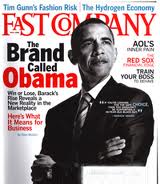
During the 2008 campaign, Fast Company magazine called Obama a brand. Sadly, it turns out that they were right. Like most brand advertising, Obama identified with people and projected the things people wanted for their country, without having the will or ability to deliver. He lifted up a new ideal of government, creating at the same time a great height to fall from. He had a huge job that required Lyndon Johnson or FDR or Truman levels of courage and skill to pull off. But he hasn’t displayed that talent, the ability to push for common ground while being simultaneously willing to smack the opposition.

When Republicans campaign, they’re nasty bastards. They will do ANYTHING to win. If you want to sell a war, talk about mushroom clouds over American cities. If you want to boost the debt to sky high levels, suggest that gays getting married will cause the collapse of the civilization. If you’re opposed by a war hero, make him look like a total pussy. Mitt Romney’s multiple positions on everything tells you everything you need to know. They just put their heads down and charge.

Democrats on the other hand need to look like they’re fair. They want to be seen as standing on the moral high ground and knowing what’s best for all of us. They say they want everyone to get along when in reality they just want everyone to think like them or shut up. They want to be superior, but are inept at using power. They act like a brand new manager who believes the title should give them respect and action from subordinates. As most of us know, those managers get smoked, usually by one of their underlings. The next job you see them at they’re the boss from hell.

Continue reading “Must See TV: America on the Edge! | Peter Mehit”

10 Things I Learned from ‘We Are Anonymous’ | Peter Mehit

I read Parmy Olsen’s ‘We Are Anonymous’ over the weekend. It is the story of the infamous hacker collective that brought down the Church of Scientology, Pay Pal, Master Card, Visa, Sony, the FBI and CIA among their numerous conquests. It’s a fascinating read about a group based on a contradiction: A few very talented, capable, creative people performed truly heinous acts because they thought their lives were pointless. This nihilistic perspective drove them until they were caught.

The participants were young. The oldest was 28, the youngest 16. Uniformly, they were the socially awkward. They were bullied and marginalized for most of their lives. Most left the education system in middle school because they were bored or mistreated. All of them lived with parents or relatives, reeking havoc on some of the largest organizations in the world from their bedrooms.

Anonymous was more of accident than a movement. The book details how the hacker collective transitioned from a  chaotic, leaderless group looking for lulz (fun at other people’s expense) to very small team that stole the private information of millions of people only to give it away to secure fame and respect from the hacking community. Without recounting the book, because it’s worth reading to understand hacker culture and the underworld of the internet, I was struck by several points:

Continue reading “10 Things I Learned from ‘We Are Anonymous’ | Peter Mehit”

PEOPLE YOU SHOULD KNOW – Bill Ellermeyer | Peter Mehit

One of the first people we met when we began marketing in Orange County was Bill Ellermeyer. I met him at a mixer where I noticed the ever changing number and types of people speaking with him. Some younger, some older, people in hip hop regalia and guys in suits we’re engaged with him in conversation.

When I finally spoke  with him I noticed two things. First, I felt like I’d known the man for more than a few moments, and second, he was an incredible listener. How this listening manifested itself was he asked questions that got at what I was thinking, not just saying. Within a ten minute conversation, he had a good grasp of my business and gave me a road map of whom to speak with and where potential partners and clients might be found. All of this information was delivered with wit and enough political savvy that the relationships of the people we discussed became apparent.  It was a seminar. Then, as quick as it started it was over, both of us shaking hands and continuing to work the room.

This is what Bill Ellermeyer does. He sees patterns. He makes connections. He then takes that vision and applies it to his clients who are primarily executives exiting the corporate world in search of the next illusive job or in some cases coming to grips with the idea that the next position won’t be there for them at all.

Continue reading “PEOPLE YOU SHOULD KNOW – Bill Ellermeyer | Peter Mehit”

The Boy Can’t Help It | Peter Mehit

He heads upslope with purpose. He’s so focused that he steps over the spread out blankets and coolers, around the playing children and conversing adults without looking at them. He’s worked out an audio problem with speakers that flank a giant 100 foot wide inflatable movie screen and now he’s trudging back to the make shift projection booth with a scant twenty minutes to make sure all is in order for a screening of ‘Kung Fu Panda’.

Even while double checking connectors and dialing in the projector, he is aware of what his team is doing. It’s almost as if he has radar. Every so often he’ll stand up and use hand signals to communicate with one of his team down by the screen. Even with the occasional miscommunication, it’s pretty impressive.

Eventually the sun sets and the movie begins. About 2,000 people fill the bowl shaped park, settling in for the show. Hollywood Outdoor Movies has yet another successful program under its belt. This event, one of a series of publicity events for Bank of America, represents one several corporate events the company has done. The client list sports marquee clients any company would be proud to have: Dreamworks, Walt Disney, NASA, MGM, American Film Institute, AMC Theaters, KIA Motors and Univision to name a few. The business has broken a million dollars in top line revenue for the first time in 2011 and is seeking capital to quadruple that in 2012.

Continue reading “The Boy Can’t Help It | Peter Mehit”