 French company Uzer’s ‘Eugene’ is a waste bin with a smart twist. One of the biggest barriers stopping people from recycling, tragically enough, is that many people simply don’t know what can be recycled and what should be thrown into the trash. Eugene is able to recognize the packaging for nearly any product, and it can tell its owner which receptacle it should go in.
Category: New Business ideas
World’s First Farm to Use Solar Power and Seawater Opens in Australia | Ecowatch
 Sundrop Farms, a tomato production facility that is the first agricultural system of its kind in the world, celebrated its grand opening in Port Augusta, South Australia, Thursday.
Instead of soil, pesticides, fossil fuels and groundwater, Sundrop Farms uses only solar power and desalinated seawater to grow tomatoes across 49 acres. The water is pumped into the facility from the Spencer Gulf about 1.2 miles away where it is desalinated to water the farm’s 180,000 tomato plants.
“The farm’s solar power is generated by 23,000 mirrors that reflect sunlight towards a 115-meter (377-foot) high receiver tower. On a sunny day, up to 39 megawatts of energy can be produced—enough to power the desalination plant and supply the greenhouse’s electricity needs,” NewsScientist explained.
Sunflare’s new ultra-thin solar “wallpaper” can stick to any surface | Inhabitat
 Imagine being able to tape thin, affordable solar cells anywhere: the top of a trailer, the side of a building, or the roof of your car. Sunflare‘s new solar technology could make that possible.
The Los Angeles-based startup has developed solar cells just a few micrometers thick that “can be secured to any surface with a special double-sided tape,” according to company founder Len Gao. The Los Angeles-based Sunflare team spent 16 years developing their ideal solar cell made with copper, indium, gallium, and selenide. The solar cells are said to be superior to traditional solar technologies in terms of weight and efficiency, generating 10 percent more power and weighing 65 percent more lightweight than other panels. Sunflare’s CIGS solar cells are affordable too, potentially costing as little as $1.07 per watt.
Source: Read More
Very Good Light Is the Men’s Beauty Website Courting Generation Z | Fashionista
While fashion writer David Yi was still working at Mashable, a thought occurred to him: Surely, there were other men out there — men like his coworkers who didn’t work in the fashion space — who were interested in beauty beyond the standard-issue “beard oil” grooming stories being promoted by mainstream men’s publications.
“I was at lunch one day with one guy and I was like, ‘Let me ask you a question, would you ever use concealer?’ and he’s like, ‘Oh David, I’m using it now!'” Yi recalls with a laugh. “He was like, ‘Honestly, I don’t need my boss knowing that I got all kinds of ratchet at 4 A.M., so I need to have an under eye concealer so he doesn’t know I went out last night.'”
DIY lamps made from plastic bottles are helping solve the world’s electricity woes | Mashable
 A project called ‘Liter of Light’ is hoping to bring light to places that need it most, by using DIY lamps made from plastic bottles. Mashable caught up with the founder of the project to hear how it works and find out who can benefit.
One of the immediate impacts of a natural disaster, like the hurricane that recently wreaked havoc in Haiti, is that it’s often followed by darkness. It takes months for aid, and in this case light, to reach the most remote places.
On a daily basis, more than 1.5 billion people face similar darkness, or at best the dim glow of candlelights or kerosene lamps, whose fumes are poisonous.
Some of these communities are extremely remote and have no access to electricity. Others have access to electricity, but opt out of using it because it’s so expensive.
The problem goes far beyond the lack of light. It extends to long-term issues about security, independence, health and access to education.
An open source project called ‘Liter of Light’ is trying to change this by using plastic bottles to make simple solar-powered lights.
Flybrix Turns Your Legos Into DIY Minidrone Masterpieces | WIRED
 THE FLYBRIX TEAM didn’t set out to build an adorable DIY mini-drone out of Lego bricks. But as any road-tripper can tell you, sometimes the journey turns out to be more fun than the destination.
Amir Hirsch has a masters from MIT. Robb Walters has a PhD from Cal Tech. And Holly Kasun has a marketing background that spans from Nike to Nokia. Together, they set out to make small drones smarter, not STEM toys.
“What we were doing originally is going after autonomous flight for microdrones, using computer vision and some other technical milestones,” says Kasun. “While we were developing our product, we used Lego bricks to rapidly prototype our early drone designs.”
How Adam Fleischman Built Umami Burger Into an Empire | Inc.com
 How long did it take you to figure out the Umami burger recipe?
About five minutes. I was trying to start a business around umami, a savory flavor that’s found in every country’s cuisine. Basically, I Googled the foods highest in umami and took out my cast-iron pan and improvised a recipe with some ground beef. The concept of the restaurant was also quick. I just wanted to make Umami Burger gourmet, an adult place that had waiters and served alcohol.
Tiger Beer creates Air Ink – first ink made from air pollution via Marcel Sydney + Graviky Labs | Campaign Brief
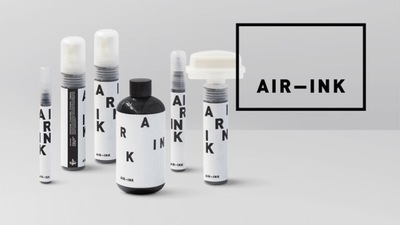 Tiger Beer, in collaboration with MIT-spinoff Graviky Labs and agency Marcel Sydney, has launched Air-Ink; an innovative range of pens, markers and spray cans made from air pollution.
To create Air-Ink, unique devices were developed to capture soot from vehicles’ exhausts. These were fitted to trucks, ferries, chimneys and even cranes around Hong Kong and India. The captured pollutants were then purified and turned into safe, reliable ink for everyday use.
Overall, 150 litres of Air-Ink has been produced, approximating to 2500 hours worth of diesel car emissions.
Brew it (cider) yourself with Alchema | TechCrunch
 Things are starting to get a bit crowded in the world of automated home brewing, with startups like PicoBrew, Brewie and BrewBot all more or less vying for the same small sliver of space. And while these machines have raked in their share of dough through crowdfunding efforts, it seems pretty likely that actual retail interest will be enough to maintain all comers.
Alchema, on the other hand, just might be different enough to keep people interested. The company’s certainly secured its share of crowdfunding success, scoring $344,231 – several times its $80,000 goal – on Kickstarter earlier this year. Unlike the majority of other entrants in the space, Alchema’s not focused on beer. The company’s tagline, “turn fruit into alcohol” says it all, really.
‘renegade’ is the pen that recycles plastic bottles into 3D printed sculptures | Design Boom
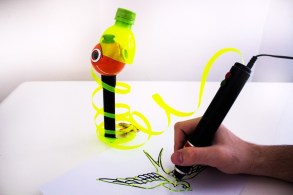 ‘renegade’ is the pen that recycles plastic bottles into 3D printed sculptures
‘renegade’ was born with the aim of being the perfect solid tool to eliminate overpriced 3D printing filaments and to save the environment by directly recycling and reusing household plastic waste for 3D printing. the sustainable technology specializes in one thing, and one thing only — it prints models by recycling plastic bottles, files, and bags. it does this providing a great 3D printing experience with no compromises.
 Dispatches From The Front