As solar panels wear out, this massive recycling plant in Yuma, Arizona | Fast Company

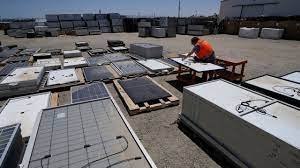
Sunlight beats down on a graveyard for dead solar panels in Yuma, Arizona, hundreds stacked in neat piles, waiting for their next life. The great majority of worn and damaged panels are still dumped in landfills. But with more and more piling up, many people know that needs to change.

In this desert city where Arizona, California, Sonora, and Baja California meet, North America’s first utility-scale solar panel recycling plant has opened to address what founders of We Recycle Solar call a “tsunami” of solar waste. Plans to address climate change rely on massively scaling up clean, solar electricity.

The panels, stacked and banded, come here from the company’s main collection warehouse in Hackettstown, New Jersey, plus six other locations across the country.

Read More

Ultra Thin Coating For Solar Panels | Cool Business Ideas 

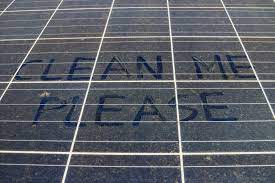
Solar panels can’t operate efficiently if they’re caked in dirt, but cleaning them regularly can become a time-consuming process. Engineers in Germany have now developed an ultra-thin coating that can make solar panels and other surfaces self-cleaning.

Solar is the biggest source of renewable energy, and it’s growing quickly. But as you could imagine, it’s not feasible to send someone out with a squeegee to clean millions of solar panels in each park. Having them clean themselves would be ideal – and now researchers at the Fraunhofer Institute in Germany have made strides towards that concept.

The team created a coating that changes its response to water based on the time of day, allowing it to shed any buildup of dust and dirt fairly quickly. The key ingredient is titanium oxide, which in its normal state repels water, forming drops that easily roll off. When the titanium oxide is exposed to UV light, however, it changes state to become highly water-attracting, which keeps the surface wet with a thin layer of water.

Read More

Should you install solar panels on your roof? Ask Google | Mashable

In 2015, Google launched Project Sunroof, a map that shows which houses have enough sun exposure for solar panels to be a viable energy source. However, the original map was very limited, covering only the San Francisco Bay Area, Fresno, California and Boston.

Now, Google has greatly expanded the project to cover all 50 U.S. states, with a total of 60 million buildings in the database.

Read More

How Do Tesla’s Home Batteries Work? | Live Science

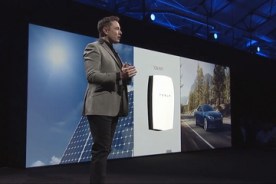
Last week, Tesla Motors announced an ambitious new product line: batteries to power homes or businesses.

The idea is that homes and businesses powered by solar panels could harvest and store energy during the day that could be used to run homes at night, or be used as a backup during a power outage.

“Our goal is to fundamentally change the way the world uses energy,” the company’s founder, Elon Musk, said at a news conference April 30. [Creative Genius: The World’s Greatest Minds]

Although the exact technology involved in the battery, called Powerwall, is a closely guarded secret, it probably isn’t based on revolutionary concepts, said Jordi Cabana, a chemistry professor at the University of Illinois at Chicago who studies new battery materials.

“Just looking at the specs that they publicize, it doesn’t look very different — in terms of the cost — to what they’re putting in their cars,” Cabana told Live Science.

Read More.

This bike path is made entirely of solar panels | Public Radio International

If you could get up on the roof of our offices in Boston, you’d be standing amongst a bunch of solar panels. That’s not so unusual.

But in The Netherlands, they’re experimenting with putting solar panels in a much more unusual place: Bike paths.

A bike path made of solar panels opened today in a suburb outside of Amsterdam. Just 230 feet of it exist. Designers say it’s enough to power three homes.

But is it worth the cost? Many in this cycling crazed culture say yes.

“It’s incredible. It’s the world’s first ever public, solar cycle path,” says the BBC’s Anna Holligan. “There are actually more bikes than people in this country. It’s famous for cycling. So it’s the right place to be testing this pioneering technology.”

Read More.