Why the Twilight Exit Will Buy You a Steak Dinner If You Close Your Chase Bank Account – Seattle News – The Daily Weekly

He was watching customers pay with cards furnished by the company he felt was trying to screw him, all in the name of keeping a little extra of his money every month. It’s illegal to offer free booze to entice customers.
But free meat? Fair game.

“If someone wants a steak dinner,” he says. “I will feed them.”

Read Article

.

Finding a Good Financial Bill in 2,300 Pages | NYTimes.com

I did something I doubt few people have dared. I took the liberty of a 13-hour flight back from Asia earlier this week to read all 2,300-plus pages of the bill. Yes, all of them.

My law professor verdict: There are many things to applaud in this bill and much in there that will substantially enhance the government’s power to regulate the financial industry. On the whole, if you think that the financial industry needs more supervision and financial regulators more tools, you should be relatively happy. If you are an advocate of big world changing ideas like breaking up the banks, you will be less so.

Read Article.

How Goldman gambled on starvation | Johann Hari – The Independent

Goldman Sachs must die:

At the end of 2006, food prices across the world started to rise, suddenly and stratospherically. Within a year, the price of wheat had shot up by 80 per cent, maize by 90 per cent, rice by 320 per cent. In a global jolt of hunger, 200 million people – mostly children – couldn’t afford to get food any more, and sank into malnutrition or starvation. There were riots in more than 30 countries, and at least one government was violently overthrown. Then, in spring 2008, prices just as mysteriously fell back to their previous level. Jean Ziegler, the UN Special Rapporteur on the Right to Food, calls it “a silent mass murder”, entirely due to “man-made actions.”

Read Article.

Failing Big Banks? Euthanize ‘Em! | Mother Jones

It’s a plan Volcker has been pushing since he emerged on the financial-reform scene in the past year or so, and Obama so far seems to be support some kind of bank wind-down process. “You get very aggressive traders, and they’re out there,” Volcker said. “Millions of dollars are at stake, and personal bonuses, so they have a real incentive to take risks, which is fine, if you’re not being protected by the government.”

Read Article.

John Thain Makes Bold Promise He Most Likely Can’t Keep | Dealbreaker

This is poetic justice.

John Thain (not in photo) is the former CEO of Merrill Lynch who famously spent millions of dollars redecorating his offices while the firm went down in flames. At left is the office he has sworn not to alter at his new job at CIT Group.

For a man who spent $87,000 on a rug and $1,000 a yard for drapes, this is perfect.

The cardboard cutout in the photo will presumably be removed.

Sweet.

Read Article.

Find Out Where Your Money Goes! | An Occasional Series

I hear nonstop bitching from Democrats and Republicans and Independents about where all the bailout (or stimulus) money is going. This is one of those times in life where the more educated about reality you are, the better.
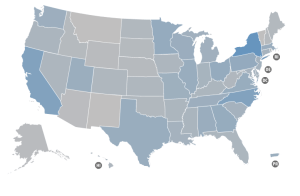
Click here to be taken to a map that shows which banks received TARP money. This is from the government website http://www.financialstability.gov. At whim or random, we will keep putting information from this site out because it’s important stuff. But really, you should become familiar with it so you at least know what the facts are (or ‘facts’ are, depending 0n your political affiliation).

You know how to tell when a politician is lying, right?

Bankers Without a Clue | Paul Krugman – NYTimes.com

Jamie Dimon of JPMorgan Chase declared that a financial crisis is something that “happens every five to seven years. We shouldn’t be surprised.” In short, stuff happens, and that’s just part of life.

But the truth is that the United States managed to avoid major financial crises for half a century after the Pecora hearings were held and Congress enacted major banking reforms. It was only after we forgot those lessons, and dismantled effective regulation, that our financial system went back to being dangerously unstable.

It’s the equivalent of “Hey, who can know why these things happen? What am I, an expert? Fuggetaboutit.”

Read Column.