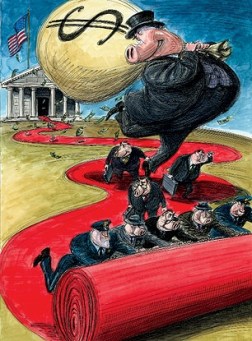
Confidential Federal Audits Accuse Five Biggest Mortgage Firms Of Defrauding Taxpayers | Huffington Post

The audits accuse the five major lenders of violating the False Claims Act, a Civil War-era law crafted as a weapon against firms that swindle the government…

The audits conclude that the banks effectively cheated taxpayers by presenting the Federal Housing Administration with false claims: They filed for federal reimbursement on foreclosed homes that sold for less than the outstanding loan balance using defective and faulty documents.
Read Article.

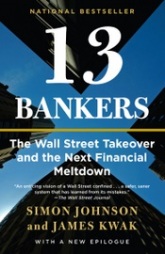
The Testimony of Simon Johnson | Congressional Oversight Committee

“…Powerful people at the heart of our financial system still have the incentive and ability to take on large amounts of reckless risk – through borrowing large amounts relative to their equity.

There is an insularity and arrogance to policymakers around capital requirements that is distinctly reminiscent of the Treasury-Fed-Wall Street consensus regarding derivatives in the late 1990s – i.e., officials are so convinced by the arguments of big banks that they dismiss out of hand any attempt to even open a serious debate.

Next time, when our largest banks get into trouble, they may be beyond “too big to fail”. As seen recently in Ireland, banks that are very big relative to an economy can become “too big to save” …

…what the Bank of England refers to as a doom loop“.

Read Document.

Why Isn’t Wall Street in Jail? | Rolling Stone Politics

…the justice system not only sucks at punishing financial criminals, it has actually evolved into a highly effective mechanism for protecting financial criminals. This institutional reality has absolutely nothing to do with politics or ideology — it takes place no matter who’s in office or which party’s in power. To understand how the machinery functions, you have to start back at least a decade ago, as case after case of financial malfeasance was pursued too slowly or not at all, fumbled by a government bureaucracy that too often is on a first-name basis with its targets. Indeed, the shocking pattern of nonenforcement with regard to Wall Street is so deeply ingrained in Washington that it raises a profound and difficult question about the very nature of our society: whether we have created a class of people whose misdeeds are no longer perceived as crimes, almost no matter what those misdeeds are.

Read Article.