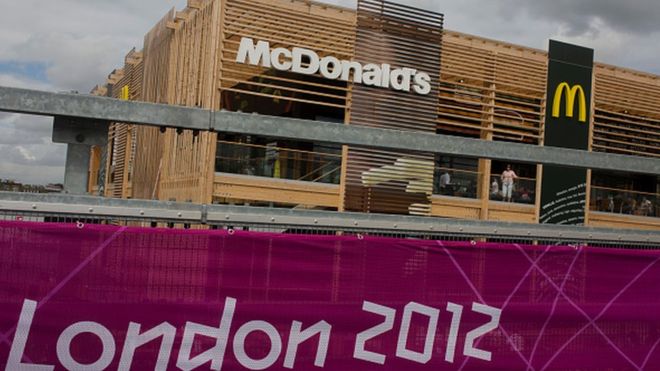
McDonald’s Ends Olympics Deal Three Years Early | BBC News

McDonald’s and the International Olympics Committee (IOC) are ending their long-running sponsorship deal three years early.
The fast food chain said it was “reconsidering all aspects of its International Olympics Committee business” as part of a plan to re-invigorate its business.

The IOC said it understood “that McDonald’s is looking to focus on different business priorities”. The partnership began in 1976.

“For these reasons, we have mutually agreed with McDonald’s to part ways,” said the IOC.

Read More

How Nike Brilliantly Ruined Olympic Marketing Forever | Adweek

Unless you happen to be a company like GE, Coca-Cola or McDonald’s—a brand that can afford the reported $100 million to $200 million it costs to be an official Olympic sponsor—you’d better not mention the Rio games in your marketing.

As social-savvy marketers have quickly learned, the U.S. Olympic Committee has ironclad regulations, backed by U.S. trademark law, that restrain nonsponsoring brands from saying anything even vaguely evocative of the Olympics. A casual mention of Rio on Facebook? A congratulatory tweet to a gold medalist? Even tweeting the term “gold medal”? Don’t do it.

Read More

Russia to Remain Banned From Olympics After Doping Scandal | ABC News

Russian track-and-field athletes will remain barred from international competition over a doping scandal, the world athletics’ governing body announced today before this summer’s Olympics in Brazil.

After meeting in Vienna, the International Association of Athletics Federations (IAAF) decided not to reinstate Russia’s track and field federation, which has been suspended from international competitions after it was implicated in an elaborate alleged state-sponsored doping cover-up in November.

Russia is the first country to be excluded from the Olympics over doping. Its track-and-field athletes are banned from the Rio de Janeiro Games.

Read More

Not just Boston: Why no one wants to host the Olympics anymore | Mashable

Boston revealed Monday afternoon that it had withdrawn itself from consideration to host the 2024 Summer Olympics. The announcement came hours after mayor Marty Walsh said he wouldn’t sign any contracts that left local taxpayers on the hook for cost overruns, which are virtually guaranteed to balloon anytime anyone hosts a global sporting mega-event.

At first glance, his words may have seemed like a relatively minor act of populist defiance. Yet Boston’s thanks-but-no-thanks actually reveals something much deeper. No one wants to host the Olympics anymore — nor should they.

There are, of course, success stories — Barcelona in 1992 is seen as a win for all involved, for example. But for illustrations of why the Olympics have become radioactive for most prospective hosts, one need only look at the recent past.

Surely you haven’t forgotten Sochi last year, when journalists and athletes stepped into a chaotic construction scene just days ahead of the Games. The most expensive Olympics in history cost more than $50 billion to pull off, enriching a small minority as the rest of the country’s economy languishes. Just eight months after the closing ceremony, Sochi was described as a “ghost town.”

Or let’s look back 10 years before Sochi, to the 2004 Olympics in Athens. Greece spent $10 billion to host those Games. Today, Greece’s economy is in tatters. Could these two things somehow be related?

Read More.