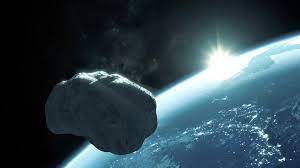
 Half a dozen fragments of the moon may briefly orbit Earth at any given time, before moving on to circle the sun, new research suggests — but the minimoons’ small size and quick pace make them challenging to spot.
When objects collide with the moon, they send up a shower of material, some of which manages to escape into space. Although there may be an occasional large chunk, most are fast-moving and smaller than 6.5 feet (2 meters) in diameter. The bulk of the lunar material falls into orbit around the more gravitationally attractive Sun. But some of the debris may occasionally be pulled into an orbit around Earth before returning to circle the sun, researchers explained in a study published in the journal Icarus.
It’s “kind of like a square dance, where partners change regularly and sometimes leave the dance floor for a while,” Robert Jedicke, a researcher at the University of Hawaii and lead author of the study, told Space.com by email.
 Dispatches From The Front