Mysterious glow at the Milky Way’s center could reshape a major cosmic theory | Live Science

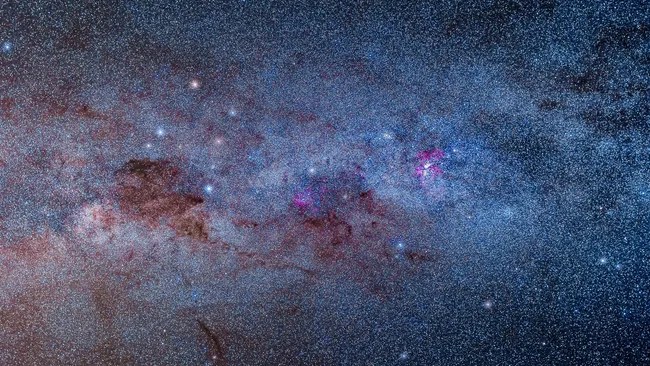
Dark matter near the center of our galaxy is “flattened,” not round as previously thought, new simulations reveal. The discovery may point to the origin of a mysterious high-energy glow that has puzzled astronomers for more than a decade, although more research is needed to rule out other theories.

“When the Fermi space telescope pointed to the galactic center, it measured too many gamma rays,” Moorits Mihkel Muru, a researcher at the Leibniz Institute for Astrophysics Potsdam in Germany and the University of Tartu in Estonia, told Live Science via email. “Different theories compete to explain what could be producing that excess, but nobody has the definitive answer yet.”

Early on, scientists proposed that the glow might come from dark matter particles colliding and annihilating each other. However, the signal’s flattened shape didn’t match the spherical halos assumed in most dark matter models. That discrepancy led many scientists to favor an alternative explanation involving millisecond pulsars — ancient, fast-spinning neutron stars that emit gamma-rays.
Read More

The Milky Way could be part of a much larger ‘cosmic neighborhood’ than we realized, challenging our understanding of the universe | Live Science

The region of the universe we live in may be significantly bigger than we thought. A new study reveals that the intergalactic supercluster holding the Milky Way may be part of an even bigger “basin of attraction” that’s up to 10 times larger than the one we currently call home.

The universe is full of basins of attraction (BOAs) — regions within which everything is being pulled inward by the gravity of a massive object. BOAs can stack inside one another like nesting dolls. For example, the moon circles Earth, which in turn orbits the sun along with the rest of the solar system, which is itself spiraling around the supermassive black hole at the heart of our galaxy.

Read More

There may be hundreds of millions of habitable planets in the Milky Way, new study suggests | Live Science

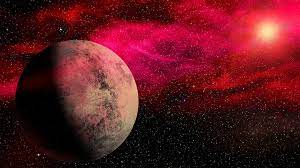
The sun is an ordinary star, but it’s not the only kind of star out there. Most stars in our galaxy are M dwarfs (sometimes called red dwarfs), which are significantly smaller and redder than the sun — and many of them may have the potential to host life, new research shows.

A new reanalysis of data from the planet-hunting Kepler mission shows that one-third of planets around M dwarfs may be suitable for life — meaning there are likely hundreds of millions of habitable planets in the Milky Way alone.

For the analysis, astronomers at the University of Florida incorporated new information from the European Space Agency’s Gaia satellite, which precisely measures the distances and motions of stars, to fine-tune measurements of exoplanets’ orbits. The researchers wanted to pin down a parameter of each orbit known as eccentricity, a measure of how stretched out the planet’s path around its star is.

Read More