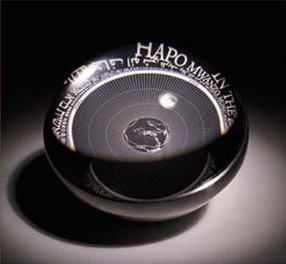
 We are at, arguably, the zenith of the human experience. On every front of art or science, both practical and theoretical knowledge built on thousands of years of human observation has accumulated into massive amounts of information stored electronically, magnetically or optically. Unlike the ancients who preserved their most valuable observations in stone, stable for thousands of years, or in books, which last hundreds, our information is stored in technology such as hard disk drives, compact disks or magnetic tape with typical lives of around 10, 15 and twenty years. In the event of a breakdown in society or technology, this information would be lost to future generations. The Rosetta Project is an attempt to develop storage that will last thousands of years while being compact.
Our first prototype of a very long-term archive is The Rosetta Disk – a three inch diameter nickel disk with nearly 14,000 pages of information microscopically etched onto its surface. Since each page is an image, rather than a digital encoding of 1’s and 0’s, it can be read by the human eye using 500 power optical magnification. The disk rests in a sphere made of stainless steel and glass which allows the disk exposure to the atmosphere, but protects it from casual impact and abrasion. With minimal care, it could easily last and be legible for thousands of years.
 Dispatches From The Front