What Google Learned Fighting Hiring Bias, Bad Meetings and Failing Products | Entrepreneur

Starting and managing a business is no easy feat, even for Google

While it’s currently one of the most powerful and respected businesses in the world, nearly 20 years ago it was just a small group of people working at a very typical startup, all-nighters and all.

“The founders [Larry Page and Sergey Brin] built the company in the image of what they saw at Stanford graduate school,” Eric Schmidt, the former CEO of Google and current chairman, told Reid Hoffman on Masters of Scale, a podcast series examining counterintuitive theories to growing a company. He added, “that graduate student culture, that sense that somehow we’re about to discover something new, permeated the decision-making, and traditional experience wasn’t present.”

Read More

PSA: This Google Doc scam is spreading fast and will email everyone you know | TechCrunch

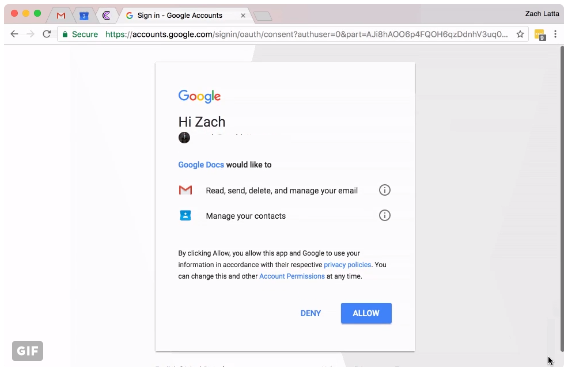
A new Google Docs phishing scam just reared its head a few hours ago, and it’s spreading like wildfire. Google appears to be taking action to stop it, but in the meantime: be super, super wary of Google Doc invites for now. If you fall for this one (and plenty of otherwise eagle-eyed people have already), it’ll blast out the bait to everyone on your contact list.

Read More

Google, the world’s top advertising company, is building an ad blocker for Chrome | Mashable

Google, the internet’s biggest advertising company, may be building an ad blocker.

The search giant plans to roll out a feature in the next mobile version of its Chrome browser that would filter out certain types of ads, the Wall Street Journal reported Wednesday,

Such a tool seems at odds with the company’s primary revenue source, but Google thinks that it could actually deter people from resorting to other blockers in the long run, according to the report.

By targeting only the most disruptive ad formats — pop-ups, interstitials, and autoplay videos, for instance — the hope is that less people will be driven to third-party software. Google already ostensibly bans many of these types of ads anyway.

Read More

Should you install solar panels on your roof? Ask Google | Mashable

In 2015, Google launched Project Sunroof, a map that shows which houses have enough sun exposure for solar panels to be a viable energy source. However, the original map was very limited, covering only the San Francisco Bay Area, Fresno, California and Boston.

Now, Google has greatly expanded the project to cover all 50 U.S. states, with a total of 60 million buildings in the database.

Read More

What If There Was A Way To Change How You Looked On Google? | CoolBusinessIdeas.com

Negative perception from consumers often results in poorer sales and margins just because of negative search results. The role of online reputation management in today’s business and media landscape is of paramount importance in today’s digital age. Finally there is a cool business that has solved the issue of unfair and biased search results from “Fake News” and the media. The Reputation Management Company has developed programs that can delete unfavorable results and replace them with relevant and real results.

Despite how huge your company is, be it a small medium sized company or a large multi-national company, customers, prospects and potentially everyone are talking about you. They will tweet how much they like about your product or how undesirable your service is on Facebook. Customer experiences are always shared through word of mouth and increasingly on the social media.

This is why it’s crucial for brands to have a professional team of search engine reputation management experts who can identify negative results and get them removed from the web before they cause any damage.

Read More

Are We Breaking The Internet? | Fast Company

Recent outages from critical services across the net have created massive disruption in recent weeks: Whether it was Amazon’s S3 service failure, which took down thousands of sites, Cloudflare’s “Cloudbleed” security issue, which forced many sites to ask users to reset their passwords, or Google Wifi’s accidental reset, which wiped out customer’s internet profiles, the infrastructure behind the internet has looked substantially more unstable recently.

The packetized technology that underlies most of the internet was created by Paul Baran as part of an effort to protect communications by moving from a centralized model of communication to a distributed one. While the Internet Society questions whether the creation of the internet was in direct response to concerns about nuclear threat, it clearly agrees that “later work on Internetting did emphasize robustness and survivability, including the capability to withstand losses of large portions of the underlying networks.”

Read More

Google Targets Cable With ‘YouTube TV’—40 Channels for $35 | WIRED

GOOGLE JUST JOINED the “skinny bundle” TV war with YouTube TV, a paid subscription service that streams a slew of premium broadcast and cable networks to your mobile device, tablet, computer, and anything with Chromecast.

Just $35 a month gets you six accounts and access to live TV from more than 40 providers including the big broadcast networks, ESPN, regional sports networks and dozens of popular cable networks. Subscriptions include cloud DVR with unlimited storage, AI-powered search and personalization, and access to YouTube Red programming. YouTube CEO Susan Wojcicki calls it the evolution of television, and a bid to “give the younger generation the content that they love with the flexibility they expect.”

Read More

Google’s new project aims to clean up comment sections | TechCrunch

If you read stuff on the internet (and obviously you do because hi, you’re reading a blog) then you know the golden rule: never read the comments.

Scrolling past the end of a story is an adventure into a realm of racism, conspiracy theories and ad hominem attacks that will quickly make you lose your faith in humanity. But instead of encountering Godwin’s Law in the comments, you might start encountering Google instead. Google’s internet safety incubator Jigsaw launched new technology today called Perspective, intended to clean up comment sections.

Perspective reviews comments and assigns them a toxicity rating that reflects the likelihood that the comment is intended to be harmful. Jigsaw’s goal is to keep people engaged in the conversation, so it assesses “harm” as something that would drive other commenters away.

Read More