
Fifteen years into the commercialization of the Internet, with people coming of age who don’t remember anything different, Davidson argues that we’re at the perfect moment to begin reimagining our institutions and developing practices to deal with the onslaught of information, the reality of constant connectedness, and the challenges of global collaboration.
Tag: future
Aircruise luxury ships floating to the U.S. in 37 hours | Mail Online
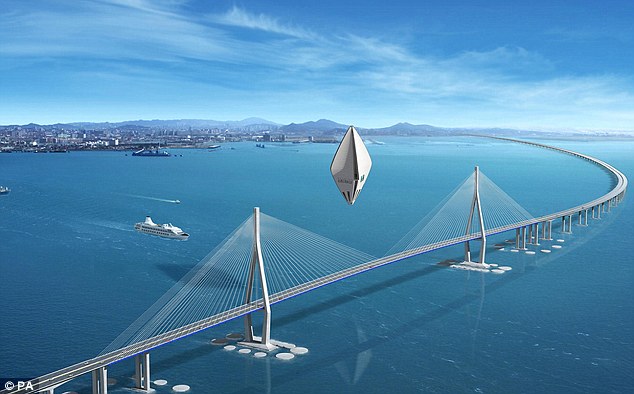
Towering, kite-shaped airships could herald a new era of luxury transport following today’s introduction of the Aircruise concept.
Standing 98ft taller than Canary Wharf, packing 330,000 cubic metres of hydrogen gas and capable of lifting 396 tonnes, the Aircruise concept features penthouse apartments, bars and even dizzying glass viewing floors.
Aircruise was created as the antithesis of a hurried, crowded passenger jet. London-based design and innovation company Seymourpowell wanted to rethink transport – on the premise ‘slow is the new fast’. It could ferry 100 people from London to New York in a leisurely 37 hours as opposed to the seven it takes now by airplane.
The Singularity and Society | Fast Company
Once possible view of the future:
The use of the term “Singularity” comes from physics, where it describes a point of collapsed space-time, typically at the center of a black hole; the underlying claim is that all of our knowledge of how the universe works is irrelevant within a Singularity. This is the root of the metaphorical use of the term–after a Singularity event, everything we know will change in ways we can’t now understand. In the early 1990s, Mathematician and science fiction writer Vernor Vinge was the first to clearly articulate this usage of the term, and begins his essay as follows:
Within thirty years, we will have the technological means to create superhuman intelligence. Shortly after, the human era will be ended.


