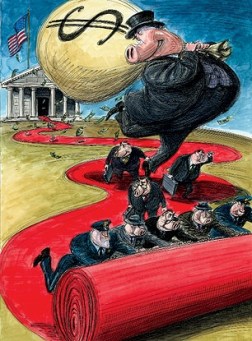
The Testimony of Simon Johnson | Congressional Oversight Committee

“…Powerful people at the heart of our financial system still have the incentive and ability to take on large amounts of reckless risk – through borrowing large amounts relative to their equity.

There is an insularity and arrogance to policymakers around capital requirements that is distinctly reminiscent of the Treasury-Fed-Wall Street consensus regarding derivatives in the late 1990s – i.e., officials are so convinced by the arguments of big banks that they dismiss out of hand any attempt to even open a serious debate.

Next time, when our largest banks get into trouble, they may be beyond “too big to fail”. As seen recently in Ireland, banks that are very big relative to an economy can become “too big to save” …

…what the Bank of England refers to as a doom loop“.

Read Document.

Women in America | The White House

“This collection of data from across the Federal government offers the most comprehensive look at women in America since the 1960s,” Acting Deputy Secretary of Commerce Rebecca Blank said. “With this report, the administration can more effectively manage programs that support women and girls and America’s families, and foster the growth of the U.S. economy.”

Each page of this report is full of the most up-to-date facts on the status of women. Of particular note
are the following:

  • As the report shows, women have made enormous progress on some fronts. Women have not only caught up with men in college attendance but younger women are now more likely than younger men to have a college or a master’s degree. Women are also working more and the number of women and men in the labor force has nearly equalized in recent years. As women’s work has increased, their earnings constitute a growing share of family income.
  • Yet, these gains in education and labor force involvement have not yet translated into wage and income equity. At all levels of education, women earned about 75 percent of what their male counterparts earned in 2009. In part because of these lower earnings and in part because unmarried and divorced women are the most likely to have responsibility for raising and supporting their children, women are more likely to be in poverty than men. These economic inequities are even more acute for women of color.
  • Women live longer than men but are more likely to face certain health problems, such as mobility impairments, arthritis, asthma, depression, and obesity. Women also engage in lower levels of physical activity. Women are less likely than men to suffer from heart disease or diabetes. Many women do not receive specific recommended preventative care, and one out of seven women age 18-64 has no usual source of health care. The share of women in that age range without health insurance has also increased.
  • Women are less likely than in the past to be the target of violent crimes, including homicide. But women are victims of certain crimes, such as intimate partner violence and stalking, at higher rates than men.

Read Report.

January/February 2011 SBA Advocate Newsletter | SBA


Release Date: February 2011

Volume 30, number 1

The Small Business Advocate is a periodic newsletter that details economic developments and regulatory trends related to small business as well as the latest initiatives of the Small Business Administration’s Office of Advocacy.

In This Issue

Executive Order 13563 to Improve Regulatory Review, 1

Text of E.O. 13563, 6-7

OSHA Withdraws Two Rules, 1

Startup America Launched, 2

Rodgers Appointed Deputy Chief Counsel, 11

New Advocacy Staff, 11

Message from the Chief Counsel

Small Business Talks; Advocacy Listens, 3

Research Notes

Small Business Economy Released, 2

Legislative Focus

Freshmen Senators Schooled in Small Business Values, 4

Regional Report

Nine Regional Advocates in Place, 8-10

Regulatory News

IRS Modifies PTIN Rule, 12

Financial Rule Delayed, 5

Major Clark Receives Public Service Award, 5

Read Newsletter

Why Isn’t Wall Street in Jail? | Rolling Stone Politics

…the justice system not only sucks at punishing financial criminals, it has actually evolved into a highly effective mechanism for protecting financial criminals. This institutional reality has absolutely nothing to do with politics or ideology — it takes place no matter who’s in office or which party’s in power. To understand how the machinery functions, you have to start back at least a decade ago, as case after case of financial malfeasance was pursued too slowly or not at all, fumbled by a government bureaucracy that too often is on a first-name basis with its targets. Indeed, the shocking pattern of nonenforcement with regard to Wall Street is so deeply ingrained in Washington that it raises a profound and difficult question about the very nature of our society: whether we have created a class of people whose misdeeds are no longer perceived as crimes, almost no matter what those misdeeds are.

Read Article.