 On a cold Denver night in 2010, Steve Katsaros walked past a building under construction that was lit up like a Christmas tree by incandescent bulbs strung along each floor, all powered by a diesel generator. “I wondered about all the fuel being used and the pollution caused by keeping those lights on,” he recalls. The next morning, Katsaros, then a patent agent at a law firm and a trained mechanical engineer, woke up and sketched a design for a solar-powered light bulb. Four days later, he filed for a patent.
4 Qualities of Dogs That You Also Want in Your Customers | All Business
 You might think dogs are an unlikely source of inspiration for your customers, but you’d be surprised how similar they can be. I don’t mean to denigrate your customers! Quite the contrary. I think if customers were more like dogs in the following four ways, we’d all have more business than we could handle.
1. Loyalty
What’s the first quality you think of when it comes to dogs? Loyalty! They’re there with wagging tails, whether we feed them, walk them, or ignore them. And when we treat them well? That loyalty skyrockets.
You already know that having loyal customers is great for business. It’s easier—and cheaper—to get past customers to come back than to find new ones. So consider ways you can build loyalty with your customer base.
Tech Bubble? Maybe, Maybe Not | TechCrunch
 I’ve heard people wonder if we’re in a bubble with regard to startups. Is it as bad as the 2000 dot-com bubble? Might it actually be worse? I thought it would be worthwhile to look at the available data to see if we can figure this out with more than just a personal opinion. So I asked our engineering team at Google Ventures to dig into the bubble question and find out what the data say. In this post, I’ll share what I learned.
Back in the late 1990s, venture capitalists got very excited about the Internet. A whole lot of money was poured into some companies that failed rather spectacularly, and a lot of people lost a lot of money.
Fast forward to 2015. If you read the headlines about multi-billion-dollar valuations for companies like Uber (one of our portfolio companies), Airbnb and Dropbox, it’s easy to see why some people are feeling antsy. Is everyone irrationally excited about new platforms and economic models in the same way folks were excited in 1999? Or is this different? There are two sides to the case.
Thanks to Google, TV Ads Are About to Start Watching You | WIRED

GOOGLE IS ABOUT to make ads on television work just like ads on the web. Through Google, advertisers will know how many times their ads were viewed. They’ll be able to target audiences based on location and viewing history. In other words, TV advertisers will have access to the same audience intel online advertisers take for granted.
Finally, after all this time, your TV is going to know as much about you as your web browser.
Bad Business Habits That Small Biz Owners Want to Break | Small Biz Trends
 Of all the bad business habits out there, which one would you most like to break? Micromanaging? Overspending? Procrastination?
Would it surprise you to learn that “wearing too many hats” is the bad business habit that 35 percent of business owners say they’d want to kick?
Yes, that’s right. Taking on too many roles and responsibilities is what more than one-third of small business owners said they want to change.
That was the top choice of bad business habits to break, in the sixth annual Brother International Small Business Survey, conducted by Wakefield Research.
We small business owners are notorious for wearing many hats. Apparently, quite a few of us do not see that as a good thing.
Weekly Economic Update | LAEDC

v.19 n. 13 – Released March 23, 2015
This Week’s Headlines:
- January State and Local Employment Report
- Events of Interest
- April 21, 2015: San Gabriel Valley Economic Outlook
Ecommerce Product Description Writing Driving You Nuts? Here are 6 Ways To Describe Almost Anything | Getentrepreneurial.com
 There I was – stuck, staring at my computer screen and gritting my teeth. “All these calculators are virtually the same. All calculators add, subtract, divide and multiply.” I huffed, “How am I supposed to write different copy for 25 calculators that are all pretty much identical?”
Ever been there? Ever had several catalog or ecommerce descriptions or pages of copy to write that deal with products that are the same, but different? What’s the biggest problem? Knowing how to identify those all-important differences!
Strategy #1 – Create a List of Methods Used Before
One way to get around this would be to make a list of the different ways you have described products in the past. Then, you can simply refer back to your list for ideas. If you’ve written about USB speakers before, check your copy to see how you described them. Can some of that information be repurposed for current descriptions? Create your own cheat sheet.
Strategy #2 – Problem/Solution
What problem does the product solve? And for whom does it solve the problem? Here’s one example from Sauder:
Wanted: Women entrepreneurs | CNN Money

American Underground has a lofty goal — to become the most diverse startup incubator by the end of 2016.
Why the rush?
“Great business ideas aren’t getting the opportunity to come to market because the tech community of startups and investors lacks diversity,” said Adam Klein, chief strategist with the Durham, N.C.-based accelerator.
So by the end of next year, American Underground wants women and minority-led firms to make up more than 50% of its startups. (Currently, it’s 36% of the 225 startups.)
It’s not just lip service. Klein pointed to a variety of initiatives started in 2013 to aggressively recruit more female entrepreneurs to its three campuses.
There’s a nursing room at American Underground’s main location in downtown Durham. Networking, mentoring and cocktail hour events are scheduled before 6 p.m.
An Implant Could One Day Fix Spinal Cords And Let People Walk Again (Rats Already Are) | Co.Exist
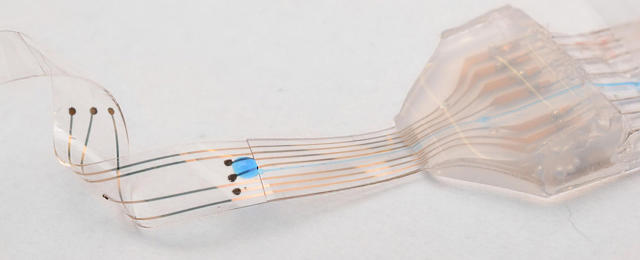 Here’s how we might fix spinal injuries in the future: with an implant that reconnects our body with the rest of our nervous system.
Researchers at the Swiss Federal Institute of Technology, in Lausanne, have developed the e-Dura—a tiny skinlike device that attaches directly to damaged spinal cords. By sending out small electrical pulses, it stimulates the cord as if it were receiving signals from the brain, thus allowing movement.
“The purpose of the neuro-prosthesis is to excite the neurons that are on the spinal cord below the site of the injury and activate them, just like if they were receiving information from the brain,” says Stéphanie Lacour, a professor at the institute.
March Business Scan 2015 | LAECD
Kyser Center for Economic Research is pleased to provide the March 2015 issue of Business Scan, a compilation of 16 key Los Angeles County economic indicators and business trends, including employment in 7 industries, unemployment rates, trade, housing, tourism and entertainment.

