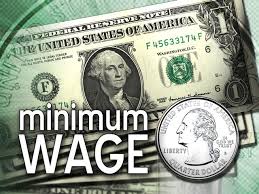
Seattle’s $15 An Hour: Measure The Unemployment Effects And There They Are | Forbes

downloadWe do keep being told this most delightful story: that raising the price of something isn’t going to change demand for that same thing that has just risen in price. This does rather contradict most of what we know about economics and the price system: demand curves do slope downwards after all.

True, there is one well known exception, what is called a Giffen Good (the definition of which is a good where the demand curve does not slope downwards). The only proven examples of this are wheat noodles in North China and rice in South China. But the general point is accepted that it probably applies to the subsistence carbohydrate in subsistence economies. People are living so close to the starvation line that when the price of the basic foodstuff goes up they have to cut their expenditures on other foods (possibly, little tasties or sauces to get that basic glop down) and increase their demand for that basic subsistence food in order to stay alive. They’re limited by the fact that they already live so close to the 2,000 or 3,000 calories a day needed to keep going. So, this might also apply to tortillas in the poorer parts of Mexico, or mealie meal in sub-Saharan Africa and so on.

Read More.

Five Things You Don’t Know About Millennials and Teens | Ypulse

Every month, we survey 1000 13-32-year-olds to learn about young consumers’ attitudes and behaviors, and today we’re using recent data to highlight five things that you probably don’t know about Millennials and teens, from their mobile behavior to their spending habits. Not everything you’ve read about them is true…

1. THEY’RE MORE TRADITIONAL THAN YOU THINK. 

Hookup culture and all those “newfangled” dating apps get a lot of attention, but in reality Millennials and teens are more traditional than you might think. 50% of 13-32-year-olds have been on a formal date, 25% are in a committed relationship, and 17% are married. The majority of those in a relationship met their significant other in an old-fashioned way: 32% met at school, 22% through mutual friends/family, 9% met at work. But how real is that infamous hookup culture? Only 23% of those over 18-years-old have had a one night stand. And while it’s true that sexting is a thing—34% have sexted, and 15% have “naughty Snapchatted”—the majority want stability in their romance, with 75% saying they want to be in a long-term committed relationship.

Read More.

Google Tightens How Advertisers Buy YouTube Ads | Adweek

Google wants more control over how advertisers buy YouTube ads.

On Thursday, the search giant revealed that it will cut off ad buying through DoubleClick Ad Exchange (or AdX), its programmatic network, by the end of the year.

Instead, advertisers will need to go through Google’s AdWords or DoubleClick Bid Manager, the company’s other two pieces of software that marketers use to buy search and skippable TrueView promos.

The move shows how Google wants a tighter grasp on its ad business. DoubleClick Ad Exchange works with third-party ad tech firms to help brands manage their campaigns and gain access to extra data that Google itself doesn’t provide advertisers. In those cases, the Mountain View, Calif., company doesn’t have as much control over its ad network as it may want. By contrast, AdWords and DoubleClick Bid Manager campaigns are handled by Google reps

Read More.

5 Ways to Turn an Embarrassing Failure into a Giant Success | Inc.com

getty_200397990-001_970728970450047_63217There are very few stories of success that don’t start with at least a few failures along the way. But certainly not everyone who fails succeeds. Failure can easily turn into an insurmountable hurdle that can stop you in your tracks.

So what’s the difference between those who let failure stop them from reaching their goals and those who turn failure into a giant success? It has to do with the way they respond to adversity. Here are five ways to turn failure into a giant success:

1) Accept that Failure is Part of the Journey Toward Success

Saying, “Failure isn’t an option,” quickly turns any failed attempt into a catastrophic event. The truth is, sometimes failure is unavoidable. Accepting that failure is part of the long journey to success can prevent you from panicking, even when you encounter the worst case scenario. A calm mindset is crucial to overcoming failure.

Read More.

Pfizer and Flynn Pharma accused of overcharging by CMA | BBC News

Pharmaceutical firms Pfizer and Flynn Pharma have been accused by the UK’s competition watchdog of charging “excessive and unfair” prices for an anti-epilepsy drug.

Phenytoin sodium capsules, used by 50,000 people in Britain, are made by Pfizer and sold by Flynn.

Pfizer said it was co-operating with the Competition and Markets Authority.

When Pfizer made the drug under its Epanutin brand name, the NHS spent about £2.3m on the drug, the CMA said.

This amount soared to £50m in 2013.

The CMA said Pfizer sold UK distribution rights to Flynn in 2012, but continued to make and supply the drug to the company.

Read More.

Harvard MBAs don’t want to go into banking anymore | Business Insider

downloadHarvard Business School graduates are some of the most sought-after new hires in the world.

They’re among the top choices for companies in just about every industry — including Wall Street investment banks.

It turns out, however, many of them are no longer interested in that industry.

Only 4% of the 2015 graduating class said they wanted to work at an investment bank, reports Bloomberg’s Jennifer Surane.

Of the 46 students in the top 5% of the class, only one expressed an interest in banking, according to the report.

The report cited data from a member of the graduating MBA class, who blogged about the findings of a class survey he received from the university.

Read More.

Lexus’ New Hoverboard Is Cool, But Will It Fly? | Live Science

Last month, Japanese auto manufacturer Lexus unveiled its newest product, and it’s not another luxury SUV. It’s a hoverboard.

Nicknamed the “Slide,” this flying skateboard will be tested in public for the first time on Wednesday (Aug. 5), the company announced this week in a brief video posted on YouTube. The video shows the sleek board floating over what appears to be regular cement in a skateboard park, leading some hoverboard enthusiasts to speculate that, at long last, someone has produced a flying skateboard that you can actually ride in a halfpipe or down a sidewalk.

But, if you thought Lexus’ new toy would turn you into Marty McFly from “Back to the Future Part II” (the one with the epic hoverboard chase scene), think again. Lexus’ Slide can’t actually hover over regular cement.

Read More.

The White House Launches Demo Day To Fuel Entrepreneurial Spirit In America | Fast Company

downloadDaniel Lubetzky, the founder and CEO of KIND Snacks, remembers exactly how he felt earlier this year when he was tapped by the White House to be a Presidential Ambassador for Global Entrepreneurship (PAGE).

“I’m not particularly partisan,” Lubetzky tells Fast Company. “I agree with President Obama on many fronts, though I also disagree with him on some issues. But when you’re invited to the Oval Office, you become like Silly Putty. You’re just overwhelmed by the office of the president, and you want to do your part to help your country.”

President Obama has been a keen proponent of entrepreneurship since he came into office. He started with his own administration: Last month, Fast Company published a cover story about Obama’s efforts to recruit top tech talent from companies like Google and Facebook to reboot the government, applying the principles of a lean startup to make it more efficient and technologically advanced.

Read More.

The Science of Unhappiness: Why We are Unhappier than We’ve Ever Been, and What We Can Do about It | Page19

Trendy hipster using smart phoneIn How the Mind Works, Steven Pinker sums up the essence of happiness as being happy with what we have. Today, many of us have more than any generation ever before: more health, more wealth, and more means by which to actualize our dreams. And yet we’re not the happiest people that ever were.

In his book, Happiness, Richard Layard shows how, paradoxically, we’re less content today than our ancestors were just a few decades back. Of course, this is no coincidence.

We humans are ambitious, competitive animals: no matter what we achieve, we get used to it quickly and crave more, and even people who win the lottery don’t stay elated for very long. Our thirst for more might be the reason why humans have shaped the planet like no other species has. In the modern world, however, it is also an inbuilt obstacle to feeling permanently pleased.

Read More.