 Launching a business in a saturated market can be an overwhelming experience. Depending on the industry you are in, you may have competitors that have high brand equity and those who have existed in the business for several decades. Establishing credibility and trustworthiness in a market overrun by such competitors is no easy task. But it can be done. Here are a few ways a startup entrepreneur can take on competitors with high reputation in a saturated market.
PSA: This Google Doc scam is spreading fast and will email everyone you know | TechCrunch
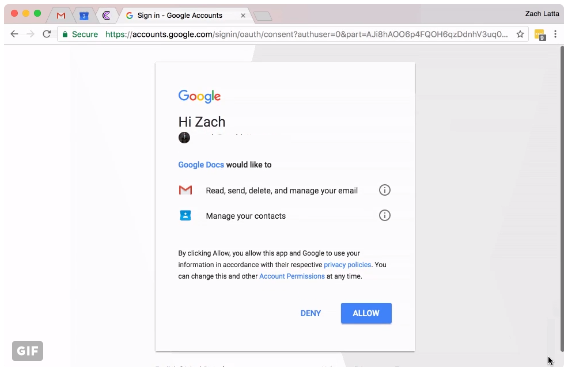 A new Google Docs phishing scam just reared its head a few hours ago, and it’s spreading like wildfire. Google appears to be taking action to stop it, but in the meantime: be super, super wary of Google Doc invites for now. If you fall for this one (and plenty of otherwise eagle-eyed people have already), it’ll blast out the bait to everyone on your contact list.
The Biggest Marketing Challenges for Small Businesses | Duct Tape Marketing
 I’ve written about marketing for small business for years and spend enough time with business owners that some might consider me an expert on the topic. In order to ensure I stay on top of trends and provide you with the most current information and tips, I continue to conduct my own research and get as much current data as possible to provide for you. I recently reached out to my friends at Alignable to get a pulse on what the biggest marketing challenges for small businesses are today and today I’d like to share a few of these insights.
More than 75% of the respondents of this survey had 1-5 employees and serve a mix of local, regional, and national customers. 22% of those polled focused solely on B2B, 19% on B2C, and 53% targeting both.
Samsung self-driving car trial in South Korea approved | BBC News
 Samsung has been given permission to start testing its self-driving cars on the roads in South Korea.
The Ministry of Land, Infrastructure and Transport approved Samsung’s plans to test its self-driving technology on Monday.
According to the Korea Herald, the company is using a customised Hyundai car for the tests.
Officials from the technology giant have denied the company has any intention of making cars.
Facebook accused of targeting ‘insecure’ children and young people, report says | Mashable
 Facebook has apologised for reportedly allowing advertisers to target emotionally vulnerable people as young as 14, as a 23-page leaked document obtained by The Australian revealed.
According to the news outlet, the document prepared by two top Australian Facebook executives uses algorithms to collect data (via posts, pictures, and reactions) on the emotional state of 6.4 million “high schoolers,” “tertiary students,” and “young Australians and New Zealanders … in the workforce,” indicating “moments when young people need a confidence boost.”
In other words, data says they feel “worthless” or “insecure” and are therefore well-positioned to receive an advertiser’s message.
Yes, Americans Are Willing To Pay For News | CBS News
 A battered news industry can find some flickers of hope in a survey that gauges public willingness to pay for journalism, as long as its leaders plan judiciously.
A little more than half of American adults regularly pay for news, through newspaper and magazine subscriptions, apps on electronic devices or contributions to public media, according to the Media Insight Project, a collaboration between the American Press Institute and The Associated Press-NORC Center for Public Affairs Research.
Here’s Why The PR Industry Is Failing | Fast Company
 It’s hard to say an industry is failing when it’s growing seven percent annually, and its ranks have swollen to nearly five professionals to every single journalist, a ratio that’s more than doubled over the past decade.
But when it comes to the current state of the public relations industry, it is.
If you have any doubt, just ask a journalist. Or just follow a few on Twitter and Facebook. You won’t have to wait long to hear them complain about bad practices in the PR industry.
Does that mean PR people are the problem? No. These same reporters will quickly point out specific publicists upon whom they rely and respect.
So what’s the problem?
Why You Can Never Find a Dinner Reservation for 7 P.M. Online | Bloomberg
 Nick Kokonas was a successful derivatives trader in Chicago who also liked to eat out. But when he met chef Grant Achatz in 2004, he discovered two things fast: the world of restaurants hadn’t kept up with the technological advances that had altered the world of finance, and the failure of restaurants to adapt to optimizing its seats the way airlines had done was a potentially giant business opportunity.
So he quit the trading floor, went into business with Achatz, and within a few years their Chicago restaurant Alinea had three Michelin stars (the highest ranking) and a list of “world’s best” awards. While Achatz cooked, Kokonas formed Tock, a different approach to restaurant reservations.
Four Fundamental Problems Bitcoin Startups are Attempting to Address | CoolBusinessIdeas.com
 Cryptocurrency sounds suspicious just by moniker. Cryptography is like a more imposing form of the word “security”, and cryptocurrency can be difficult to wrap one’s mind around. It’s an exciting and volatile new form of currency that has millennials asking themselves whether it’s time to invest.
Banks and venture capitalists don’t like uncertainty, so why is Goldman Sachs rapidly investing in Bitcoin related startups and business ventures? The answer is to stay ahead of the emerging trend (even the IRS is saying Bitcoins are taxable). Cryptocurrency is a very real phenomenon that is starting to show itself in our everyday lives. There are strong odds that you’ve shopped somewhere this week that will accept Bitcoin as a source of payment. That snowball effect has given away to some interesting startups trying to solve fundamental problems related to currency.
3 Trigger Events That Could Make Your Current Business Structure Obsolete | Entrepreneur
 Over the course of running your business from day to day, I’d imagine that examining the merits of your company’s business-entity structure rarely makes it to the top of your to-do list. And yet, the truth is your business’ legal structure can weigh pretty heavily on your financial future. It can affect everything from liability issues to tax bills and even financing opportunities.
If you suspect your current structure isn’t meeting your needs, you owe it to yourself to look into the options. And if you’re reading this, you’ve probably already chosen a business structure at least once in your life. Even so, it’s worth reviewing the five primary structures before we dig into why you might want to change things up.

