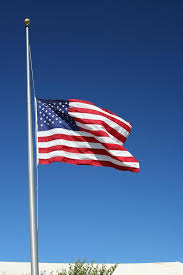
Why Is the Flag at Half-Staff Until Noon on Memorial Day? | Live Science

For 149 years, Americans have taken the last Monday in May to remember those who have died in our wars. Like all deaths honored by the state, flags fly at half-staff. However, on Memorial Day, the U.S. flag flies at half-staff only for the first half of the day, and then is raised to full height from noon to sundown. This unique custom honors the war dead for the morning and living veterans for the rest of the day.

No one knows the exact date this tradition began, but an Army regulations book from 1906 carries instructions for the procedure, so it predates the 20th century, said Clark Rogers, executive director of the National Flag Foundation. In 1924, Congress codified the tradition into U.S. Code Title 4, Section 6, with the proclamation, “For the nation lives, and the flag is a symbol of illumination,” explaining how the noon flag-raising symbolizes the persistence of the nation in the face of loss, Rogers told LiveScience.

Read More

From Wobbly Table Fixes to Herbal Refrigerators, Innovation was on Display at NRA (Part 1) | Fast Casual

More than 45,000 buyers in the restaurant industry hit Chicago this week to check out the thousands of products and services on display at the National Restaurant Association show. Many companies use the show as a platform to launch new products. Keep in mind this show takes place in North America’s largest convention center, which is two miles long from end to end, according to one employee.

See below for a roundup of several gadgets, products and services designed to make running a restaurant easier and more profitable.

Read More

How New Moms Can Deal With Maternity Leave Bias | Fortune.com

Nearly 20 years ago, I took 16 weeks off as an audit partner at Deloitte for my son’s birth. I wish I could say I felt at ease with the idea of being on extended leave, but I didn’t. At the time, I felt concerned for my career trajectory and wondered if my absence would affect my colleagues’ and leaders’ view of my work ethic and commitment.

Thankfully, I chose to follow my mentor’s advice, which ended up being an incredibly valuable life lesson: There are times in your career when you give and times when you take.

Read More

Prioritize Context to Personalize Your Marketing | Adweek

Marketers know they need to personalize their messaging to reach and engage consumers. The problem is, they’re just not sure how to execute it successfully.

Too often, they believe they can home in on personalization by identifying data patterns but that’s just one hurdle. More importantly, they need to prioritize context. Doing so will maximize one-to-one marketing campaigns and allow brands to become closer to the consumer by understanding their everyday behaviors and genuine interests.

We’ve identified three key elements marketers should consider when utilizing context to bolster a personalized marketing campaign.

Read More

How a Supreme Court Ruling on Printer Ink Bolsters Your Digital Rights | WIRED

THERE’S A REASON everyone hates printers. They break, jam, and always run out of cyan ink—which, inexplicably, also breaks them. Even when they work, toner costs so much you have to give up avocado toast for a month to buy more. As Matthew Inman, one of the great poets of his time, famously said: “Either printer ink is made from unicorn blood or we’re all getting screwed.”

Impression Products wanted to make toner a bit cheaper by refilling Lexmark printer cartridges. Lexmark of course hated that and sued. The fight dragged on for years, and made it all the way to the US Supreme Court. This week, the highest court in the land ruled against Lexmark. You may consider this an insignificant tussle over printer toner, but this important ruling clears the way for small businesses to fix your stuff—even without the manufacturer’s permission.

Read More

A quarter of shopping malls will close, according to Credit Suisse | Business Insider

About a quarter of US malls will most likely close within the next five years, according to a new prediction from Credit Suisse.

In a research note published Tuesday, the bank estimated that 20% to 25% of the nation’s 1,100 shopping malls — or roughly 220 to 275 shopping centers — would shut down by 2022.

Credit Suisse cited mass store closings, the rise of e-commerce, and the growing popularity of off-price chains — which tend to be located outside shopping malls — as reasons for the potential mall closings.

Read More

Uber’s Driverless Truck Unit Is Under Government Investigation Following Unapproved Tests | Forbes

California regulators are preparing to conduct a site inspection of the San Francisco headquarters of Uber’s autonomous truck unit, formerly known as Otto, to determine whether the company broke state law when it tested driverless trucks on public highways without permission.

The unscheduled visit, which officials from the state’s Department of Motor Vehicles are coordinating with the California Highway Patrol, is to “see the capabilities of Otto’s trucks in person,” a DMV spokeswoman said. The inspection comes months after the publication of an internal Otto document from 2016 detailing the company’s testing procedures for its self-driving semi-trucks.

Read More

United Airlines President Says If You’re Uncomfortable in Coach, It’s Your Own Fault | Inc.com

Absurdly Driven looks at the world of business with a skeptical eye and a firmly rooted tongue in cheek.

They feel your suffering.

They understand your pain as if it were their own.

They watch you struggle and they wish they could do something about it.

I’m talking about airline executives. And I’m lying.

I’ve been moved, you see, by the words of United Airlines president Scott Kirby.

Skift managed to get wind of his thoughts from a recent town hall meeting with employees. I fear you may find some of his sentiments a bit of a drag.

Read More

What Non-Retirees Mean for the Workforce | PROFITguide.com

For all Hunter Harrison’s unquestionable talents, he is really bad at one thing: not working. The celebrated railway executive officially retired from Canadian National Railway Company (CN) in 2009, after a long career running railways. A little more than two years later, at the encouragement of activist investor Bill Ackman, Harrison came out of retirement to become president and CEO of Canadian Pacific Railway (CP).

His plan was to step away, again, this summer, when he was scheduled to hand the CEO reins to longtime lieutenant Keith Creel and start a three-year tenure as a consultant (or, in his own words, a “hired hand”) to the railway. That arrangement suggested the transition of power would be a gradual process. But earlier this year, CP announced Harrison would be departing immediately to pursue other opportunities. For his early departure, Harrison will forfeit some $118 million in benefits that had been awaiting him. Hours later, several reports emerged suggesting that Harrison will be partnering with another activist investor to take control of U.S. railway CSX Corp.

Read More