New study reveals why time seems to move faster the older we get | Live Science

Scientists may be closer to understanding why time seems to pass more quickly as we age — and brain scans of people watching an old Alfred Hitchcock show helped them address this enduring question.

In a study published Sept. 30 in the journal Communications Biology, scientists pulled data from the Cambridge Centre for Ageing and Neuroscience (Cam-CAN), a long-term brain-aging research project. In total, 577 people had previously watched an excerpt from the old television series “Alfred Hitchcock Presents” — specifically, eight minutes of an episode called “Bang! You’re Dead.” As the study participants watched the clip, functional MRI (fMRI) scans were recorded; these scans would provide a measure of how the participants’ brain activity changed over time.

This particular clip was chosen because previous research showed that, compared with other video clips, it elicits the most synchronous patterns of brain activity in a wide variety of viewers. That makes it ideal for studying how the brain divides and tracks unfolding events.

Read More

Mysterious glow at the Milky Way’s center could reshape a major cosmic theory | Live Science

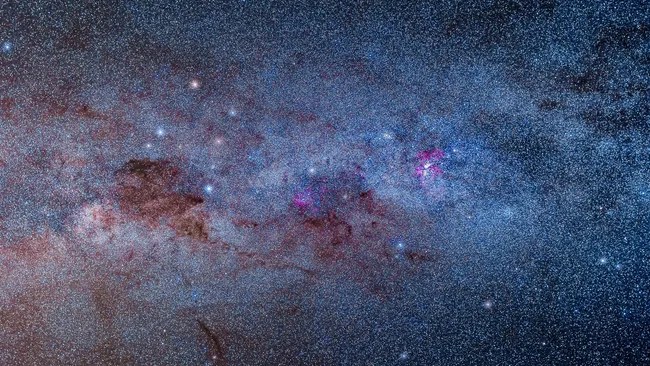
Dark matter near the center of our galaxy is “flattened,” not round as previously thought, new simulations reveal. The discovery may point to the origin of a mysterious high-energy glow that has puzzled astronomers for more than a decade, although more research is needed to rule out other theories.

“When the Fermi space telescope pointed to the galactic center, it measured too many gamma rays,” Moorits Mihkel Muru, a researcher at the Leibniz Institute for Astrophysics Potsdam in Germany and the University of Tartu in Estonia, told Live Science via email. “Different theories compete to explain what could be producing that excess, but nobody has the definitive answer yet.”

Early on, scientists proposed that the glow might come from dark matter particles colliding and annihilating each other. However, the signal’s flattened shape didn’t match the spherical halos assumed in most dark matter models. That discrepancy led many scientists to favor an alternative explanation involving millisecond pulsars — ancient, fast-spinning neutron stars that emit gamma-rays.

Read More

Black Moon in August: What it is, what it isn’t, and how to ‘see’ it | Mashable

There’s a Black Moon on the rise, but if that phrase conjures a similar Creedence Clearwater Revival lyric in your head, relax: This one isn’t bound to take your life.

A so-called Black Moon isn’t an astronomical term, but it is a mysterious nickname that, confusingly, could refer to a couple of different lunar scenarios.

The buzz right now centers on an event (or non-event, depending on how you think of it) happening Aug. 23. When an astronomical season, which is about three months long, includes four “new moons” rather than three, the third one is sometimes called a Black Moon. This happens about once every 33 months.

Read More

Earth may have at least 6 ‘minimoons’ at any given time. Where do they come from? | Live Science

Half a dozen fragments of the moon may briefly orbit Earth at any given time, before moving on to circle the sun, new research suggests — but the minimoons’ small size and quick pace make them challenging to spot.

When objects collide with the moon, they send up a shower of material, some of which manages to escape into space. Although there may be an occasional large chunk, most are fast-moving and smaller than 6.5 feet (2 meters) in diameter. The bulk of the lunar material falls into orbit around the more gravitationally attractive Sun. But some of the debris may occasionally be pulled into an orbit around Earth before returning to circle the sun, researchers explained in a study published in the journal Icarus.

It’s “kind of like a square dance, where partners change regularly and sometimes leave the dance floor for a while,” Robert Jedicke, a researcher at the University of Hawaii and lead author of the study, told Space.com by email.

Read More

New York to Los Angeles in 3 hours? Executive order could make it possible by 2027, reopening the door for commercial supersonic flight | Live Science

Supersonic commercial travel could soon be coming to the U.S. following a new executive order lifting a 52-year ban on overland commercial supersonic flights.

While supersonic flights could cross the Atlantic, the U.S. Federal Aviation Administration (FAA) banned overland commercial supersonic flights in 1973 in response to public pressure over noise concerns. The new executive order, issued on June 6, lifts that ban and lays out a timeline for the introduction of noise-based certification rules for supersonic flights.

This move could cut travel time between New York and Los Angeles almost in half, from six to just 3.5 hours.

Read More

The Milky Way could be part of a much larger ‘cosmic neighborhood’ than we realized, challenging our understanding of the universe | Live Science

The region of the universe we live in may be significantly bigger than we thought. A new study reveals that the intergalactic supercluster holding the Milky Way may be part of an even bigger “basin of attraction” that’s up to 10 times larger than the one we currently call home.

The universe is full of basins of attraction (BOAs) — regions within which everything is being pulled inward by the gravity of a massive object. BOAs can stack inside one another like nesting dolls. For example, the moon circles Earth, which in turn orbits the sun along with the rest of the solar system, which is itself spiraling around the supermassive black hole at the heart of our galaxy.

Read More

Are zebras white with black stripes or black with white stripes? | Live Science

Zebras are iconic for their distinctive coats, but have you ever wondered whether zebras are white with black stripes or black with white stripes?

The stunning black-and-white coloration of the zebra’s hide stands out in stark contrast with the dry, brown-and-green, treeless grasslands and savannah woodlands of their home territories of East and southern Africa, according to the African Wildlife Foundation.

These stripes are unique to each individual. There are three zebra species living today — the plains zebra (Equus quagga), the mountain zebra (E. zebra) and the Grevy’s zebra (E. grevyi) — and each of those species has a different striping pattern, too. For some, the darker portions of their hide are black, whereas others have browner coloring, and some have stripes only on their bodies but not on their legs. An extinct subspecies of the plains zebra called a quagga (E. quagga quagga) had minimal striping on its head, mane and neck, according to The Quagga Project.

Read More

NASA Offers Tips on What to Look Out for in May’s Night Sky | Digital Trends

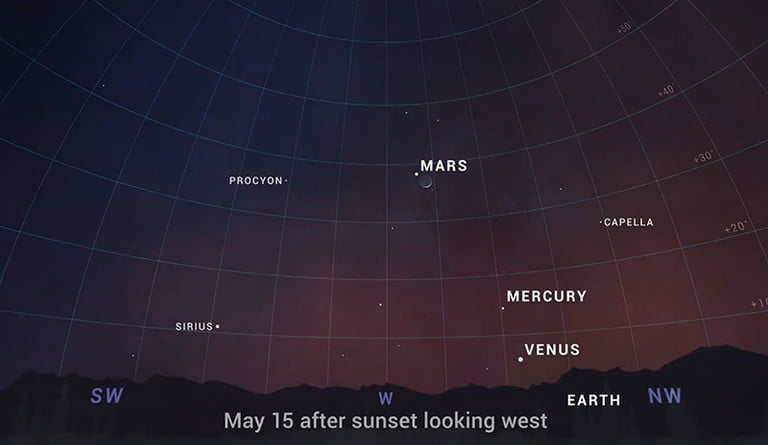
NASA has returned with its monthly update on the viewable treats in the night sky during May 2021.

Moon, Saturn, Jupiter triangle

First up, early on Tuesday, May 4, you’ll be able to spot a large triangle formation comprising the moon, Saturn, and Jupiter. With clear skies and a body clock that keeps you awake in the small hours, you’ll be able to spot the formation in the east-southeast, with Saturn rising first at 2:17 a.m. ET. The moon and Jupiter will appear to the lower left of Saturn at around the same time, at 3:01 and 3:02 a.m., respectively, with Jupiter about 10 degrees further to the left of the moon.

Read More

Halley’s comet meteor shower: Watch live or stream online | Fast Company

If you need a break from the relentless tide of data visualizations detailing unemployment rates, coronavirus cases, and deaths of people and businesses, we feel you. And so does the universe.

Monday night into the wee hours of Tuesday morning (May 4-5) will be peak viewing time for a celestial display, when the Earth will be making its way through the Eta Aquariids, one of the meteor showers from Halley’s comet. This is especially true if you live in the Southern Hemisphere.

Read More

Why Do I Get Sore Days After I’ve Worked Out? | Live Science

You crush your morning workout — running farther, lifting heavier or getting in one more round of that circuit. But that sweet satisfaction can quickly turn to regret the next morning when you’re too sore to swing your legs out of bed.

Many of us have experienced the burning, aching, jelly-leg feeling that begins hours, or even days, after exercise. But where does it come from and why does it always show up a couple days after certain workouts?

Read More