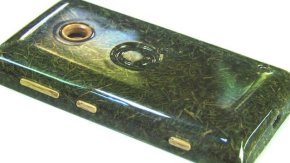
Would you buy a phone made of grass? | BBC News

It is a common complaint that most mobile phones look the same these days.

But designer Sean Miles has created one that should stand out from the crowd.

It is the first mobile phone made entirely from recycled and natural products, he says.

The phone’s casing – which is integrated into the phone – is made from recycled resin and specially treated grass clippings.

Read More.

The Entrepreneur Lighting Up Communities in Need | Inc.com

nokero_53176On a cold Denver night in 2010, Steve Katsaros walked past a building under construction that was lit up like a Christmas tree by incandescent bulbs strung along each floor, all powered by a diesel generator. “I wondered about all the fuel being used and the pollution caused by keeping those lights on,” he recalls. The next morning, Katsaros, then a patent agent at a law firm and a trained mechanical engineer, woke up and sketched a design for a solar-powered light bulb. Four days later, he filed for a patent.

Read More.

Tech Bubble? Maybe, Maybe Not | TechCrunch

I’ve heard people wonder if we’re in a bubble with regard to startups. Is it as bad as the 2000 dot-com bubble? Might it actually be worse? I thought it would be worthwhile to look at the available data to see if we can figure this out with more than just a personal opinion. So I asked our engineering team at Google Ventures to dig into the bubble question and find out what the data say. In this post, I’ll share what I learned.

Back in the late 1990s, venture capitalists got very excited about the Internet. A whole lot of money was poured into some companies that failed rather spectacularly, and a lot of people lost a lot of money.

Fast forward to 2015. If you read the headlines about multi-billion-dollar valuations for companies like Uber (one of our portfolio companies), Airbnb and Dropbox, it’s easy to see why some people are feeling antsy. Is everyone irrationally excited about new platforms and economic models in the same way folks were excited in 1999? Or is this different? There are two sides to the case.

Read More.

Thanks to Google, TV Ads Are About to Start Watching You | WIRED

GOOGLE IS ABOUT to make ads on television work just like ads on the web. Through Google, advertisers will know how many times their ads were viewed. They’ll be able to target audiences based on location and viewing history. In other words, TV advertisers will have access to the same audience intel online advertisers take for granted.

Finally, after all this time, your TV is going to know as much about you as your web browser.

Read More.

An Implant Could One Day Fix Spinal Cords And Let People Walk Again (Rats Already Are) | Co.Exist

3044063-inline-i-1-this-amazing-implant-could-fix-spinal-cords-copyHere’s how we might fix spinal injuries in the future: with an implant that reconnects our body with the rest of our nervous system.

Researchers at the Swiss Federal Institute of Technology, in Lausanne, have developed the e-Dura—a tiny skinlike device that attaches directly to damaged spinal cords. By sending out small electrical pulses, it stimulates the cord as if it were receiving signals from the brain, thus allowing movement.

“The purpose of the neuro-prosthesis is to excite the neurons that are on the spinal cord below the site of the injury and activate them, just like if they were receiving information from the brain,” says Stéphanie Lacour, a professor at the institute.

Read More.

Why Fraternities Have To Go | AskMen

It’s time to end the Greek system on college campuses — even Will Ferrell says so.

In a public Q&A via the New York Times last week, the comedian said that even though he was in a fraternity — Delta Tau Delta — during his years at the University of Southern California, the racist behavior of Sigma Alpha Epsilon brothers at Oklahoma University is “a real argument for getting rid of the system altogether.”

I couldn’t agree more. What began in the late 1700s as a small network of secret academic societies, in which young men at a few select colleges on the East Coast could gather and discuss topics deemed inappropriate by their institutions’ faculty and administrators, has devolved into a culture that not only condones abusive behavior, but in many cases demands it.

Read More.

The BMW i3 Is a Peppy, Efficient Pain in the Back | Bloomberg Business

Here’s the difference between an optimist and a pessimist.

An optimist drives the BMW i3 electric car and marvels at how great it is that he has only to lift his foot off the accelerator for the car to stop. The moment the foot releases pressure, the regenerative braking system will make actual braking—placing your foot on the pedal and pressing down—unnecessary. The car slows dramatically on its own.

A pessimist drives the BMW i3 electric car and finds himself annoyed that those blasted regenerative brakes make it feel like you’re stutter-stepping through every stoplight.

I tended toward the latter. It could be a character defect. I’m OK with that.

Immediate deceleration is not the defining characteristic of the car—the oblong body, 117-mpg efficiency, and variety of interior materials are all good candidates for that—but the sensation certainly commands your attention. And it gets more wearisome over time.

Read More.