 v.19 n. 34 – Released August 17, 2015
This Week’s Headlines:
- Retail Sales Perk Up in July
- Trade Activity Picks Up as Port of Long Beach Sets Record
- Events of Interest
- September 30: LAEDC Fall Economic Forecast
v.19 n. 34 – Released August 17, 2015

INDIANAPOLIS (May 12, 2015) – The state resolved “cramming” cases against two major mobile phone carriers as part of a multi-state settlement with Sprint and Verizon.
The mobile carriers were accused of putting unauthorized charges on customers’ cell phone bills. The state announced a similar settlement last year with AT&T and T-Mobile. As a result of the latest settlement, an estimated 750,000 Hoosiers may be eligible for refunds.
Indiana is joined by the attorneys general of the other 49 states and the District of Columbia, the Consumer Financial Protection Bureau and the Federal Communications Commission (FCC).
 Being locked in for two years was basically the norm for mobile contracts, but the changing landscape of the industry is forcing companies to reassess this model.
While T-Mobile and its brash CEO might have made the most noise with its Uncarrier marketing, others are following suit. Count Verizon as being the latest to do so.
Starting August 13, Verizon stopped subsidizing phones, and its newest price plan will kick in by offering four pricing tiers for data allocation:
Small: $30/month for 1GB of shareable data
Medium: $45/month for 3GB of shareable data
Large: $60/month for 6GB of shareable data
X-Large: $80/month for 12GB of shareable data
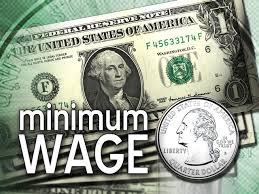
 As the proposed federal minimum wage goes up and up, economists support it less and less. In January 2014, seven Nobel laureates and eight ex-presidents of the American Economic Association signed a letter backing a federal minimum wage of $10.10 an hour by 2016, up from $7.25. They said it would “provide a much-needed boost” to low-income workers while causing “little or no” job loss. Fifteen dollars an hour is another story. None of those luminaries signed the letter in July that endorsed a Senate bill introduced by presidential candidate Bernie Sanders (D-Vt.) to raise the federal minimum to $15 an hour by 2020.
Regional economic differences are one reason a lot of economists are nervous about jumping to $15: A wage floor that’s right for New York or San Francisco could be too high for Brownsville, Texas; Gadsden, Ala.; or Ponce, Puerto Rico. In such places, $15 an hour “may have large negative employment effects,” Ronald Ehrenberg, a Cornell University labor economist, wrote in an e-mail. He was one of about 600 economists who signed the $10.10 letter last year. He says he wasn’t approached to sign the $15 letter but would have said no if asked.
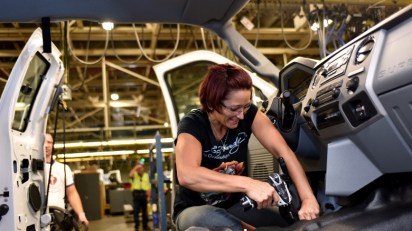
Ford’s heavy duty pickup trucks which used to be built in Mexico started rolling off an assembly line in Ohio this week.
That’s good news for the 1,000 Ford workers in Ohio, who might have otherwise been out of work.
It’s also good publicity for Ford (F), which has been under fire for investing so much in Mexico. In April, the automaker said it would invest $2.5 billion in transmission plants in the Mexican states of Chihuahua and Guanajuato, creating about 3,800 jobs there.
Ford’s south-of-the-border strategy has drawn heavy criticism from groups such as the United Auto Workers union and Republican presidential candidate Donald Trump.
The Avon Lake, Ohio, plant produced its first batch of Ford’s full-size F-650 and F-750 pick up trucks on Wednesday.
 It costs too much to do business with some people.
Who are your “some people?”
How much time do they steal from your enjoyable customers? How much energy do you give them? How much attention that can be more profitably invested in your ideal customers relationships?
You’re throwing good time, energy, attention and therefore money after bad.
So why are you doing business with “some people?”
Select one of them. Just one. The most obnoxious of the bunch.
Here are 3 Ways to Get More Ideal Customers:
 GOOGLE IS NOW many Googles.
Company co-founder Larry Page said in a blog post Monday that Google is reorganizing into multiple companies that will sit under a new umbrella operation called Alphabet. Core businesses—Search, YouTube, and Android—will operate semi-separately from Google’s myriad “moonshots,” including the X lab and Page’s various life science projects.
 v.19 n. 33 – Released August 10, 2015

DENVER — The Environmental Protection Agency says the mine waste spill into Colorado waters is much larger than originally estimated.
The EPA now says 3 million gallons of wastewater spilled Wednesday and Thursday, instead of 1 million. The revision came after the EPA used a stream gauge from the U.S. Geological Survey. An EPA-supervised crew, who was trying to enter the mine to pump out and treat the water, caused the spill. The agency has not said how long cleanup efforts will take.
But an EPA official said Sunday that she doesn’t believe wildlife will suffer significant health impacts from the wastewater from an abandoned mine in southwestern Colorado.
 We do keep being told this most delightful story: that raising the price of something isn’t going to change demand for that same thing that has just risen in price. This does rather contradict most of what we know about economics and the price system: demand curves do slope downwards after all.
True, there is one well known exception, what is called a Giffen Good (the definition of which is a good where the demand curve does not slope downwards). The only proven examples of this are wheat noodles in North China and rice in South China. But the general point is accepted that it probably applies to the subsistence carbohydrate in subsistence economies. People are living so close to the starvation line that when the price of the basic foodstuff goes up they have to cut their expenditures on other foods (possibly, little tasties or sauces to get that basic glop down) and increase their demand for that basic subsistence food in order to stay alive. They’re limited by the fact that they already live so close to the 2,000 or 3,000 calories a day needed to keep going. So, this might also apply to tortillas in the poorer parts of Mexico, or mealie meal in sub-Saharan Africa and so on.

