Twenty million people in the U.S. regularly use illegal drugs, spurring street crime and wrecking families. Narcotics cost the U.S. economy $215 billion a year — enough to cover health care for 30.9 million Americans — in overburdened courts, prisons and hospitals and lost productivity, the department says.
“It’s the banks laundering money for the cartels that finances the tragedy,” says Martin Woods, director of Wachovia’s anti-money-laundering unit in London from 2006 to 2009. Woods says he quit the bank in disgust after executives ignored his documentation that drug dealers were funneling money through Wachovia’s branch network.
Author: CBPS
Peter Mehit is co-founder and Managing Partner of Custom Business Planning and Solutions, a business consulting firm that provides problem solving, planning and process help. He has worked from private equity to the Fortune 100 at all stages.
He can be reached at pmehit@wbpllc.com or at 800-741-8444.


Congress fails to pass SBA Recovery Act – Old Rules Apply
On a vote of 57-41, the U.S. Senate defeated legislation that would have keep the increased guarantees and fee waivers in place for another year. While lending to small business has been difficult at best, the return to the old rules will mean even fewer deals get done, since the banks will have more risk.
For working capital (7a) loans less than $150,000, banks will receive an 85% guarantee and will charge a 2% fee on the guaranteed portion. From $150,001 to $700,000 the guarantee is 75% and the fee is 3%. Loans above that amount will be 75% guaranteed with a 3.5% fee.
For SBA Express loans, the cap is$350,000 with a 50% guarantee and a 2% fee.
Most banks will allow rolling these additional fees into the loan.
Linked In’s Reid Hoffman to Millennials – Welcome to the New Feudalism | Peter Mehit
 On a recent Tuesday, it was not a good day to be a millennial. They learned that, unlike any previous generation, they are entering their work life with an average of $22,000 of student loan debt. They were told by the HR chief of Intel that their liberal arts degrees (far and away the majority for them) are not valuable enough to stop the outsourcing of jobs offshore. One of their own, a 23 year old running a South Bay non-profit, described her struggles with debt and the bewildering number of jobs she’s held in the brief interval since graduation. All of this coming before Reid Hoffman, one of the founders of Linked In, declared that ‘…careers are dead’ and that they should expect to be employed as freelancers their entire working lives.
At a conference hosted by the Atlantic monthly, the National Journal and Allstate Insurance entitled “Millennials in the Next Economy” at UCLA, we learned some interesting facts about this generation who are 92 million strong. They are the most diverse generation ever: 40% are minorities. 28% are college graduates, making them the best educated (in terms of degrees, at least) of any previous generation, with 42% currently in school. 26% are seeking employment. Politicians should note that 72% are registered to vote and 39% believe the country is headed in the wrong direction.
But the one statistic that I found most interesting is, despite the economic collapse and the situation they find themselves in, 60% believe that they are in control of their own destinies, that their decisions will primarily decide the outcome of their lives.
Continue reading “Linked In’s Reid Hoffman to Millennials – Welcome to the New Feudalism | Peter Mehit”
3-D Printing From Beyond the Grave: Household Items Made From Dead People | Fast Company
This is probably the creepiest think I’ve seen in a while:
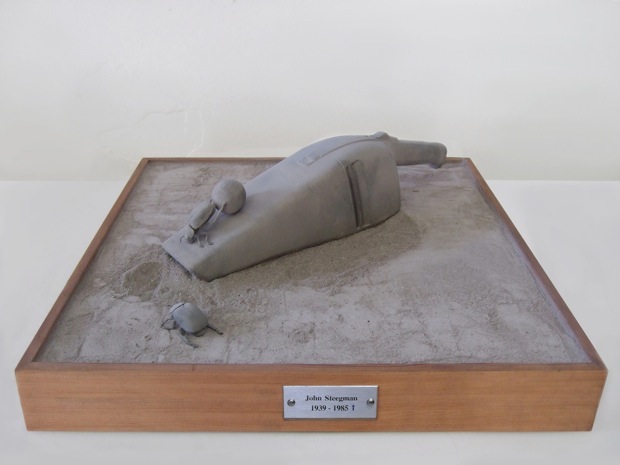
3-D Printing From Beyond the Grave: Household Items Made From Dead People | Fast Company.
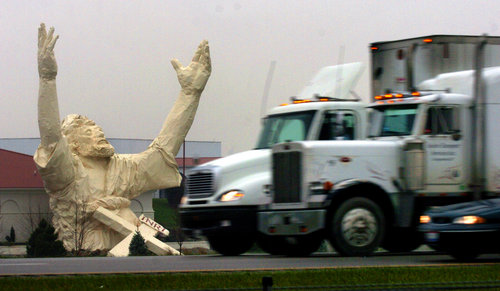
Touchdown Jesus Struck By Lightning | Springfield News-Sun
Parishioner says, “It’s not a good sign.”
Facebook’s Zuckerberg Nearly, But Not Quite, About-Faces on Privacy [Updated] | Fast Company
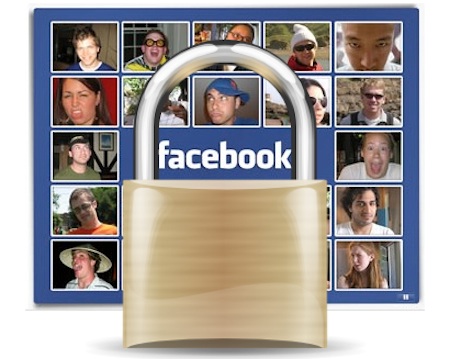
Then Zuckerberg writes the most surprising thing in the entire piece–“If people share more, the world will become more open and connected. And a world that’s more open and connected is a better world.” So Facebook is improving the world? This is rhetoric, and achieves nothing other than distracting the reader from the real news in this letter: Improving privacy.
SBA Proposes Higher Surety Bond Guarantees | SBA
SBA Proposes Higher Surety Bond Guarantees to Help Small Businesses Secure Larger Contracts in Disaster Areas
WASHINGTON – The U.S. Small Business Administration has proposed changes, including higher surety bond guarantee limits, that will help construction and service sector firms secure larger contracts for work in areas impacted by disasters.
The proposed changes, which were published as part of a Proposed Rule in The Federal Register on April 26, include:
- For a non-federal contract or order up to $5 million, a bond guarantee may be issued if the products will be manufactured or the services are performed in the disaster area.
- For a federal contract or order up to $5 million, the performance site can be outside the disaster area if the contract or order will directly assist the disaster recovery efforts.
- For a federal contract or order, the amount of the guarantee can be as much as $10 million at the request of the head of an agency that is involved in reconstruction efforts.
Continue reading “SBA Proposes Higher Surety Bond Guarantees | SBA”
Patchwork Nation | Online NewsHour | PBS
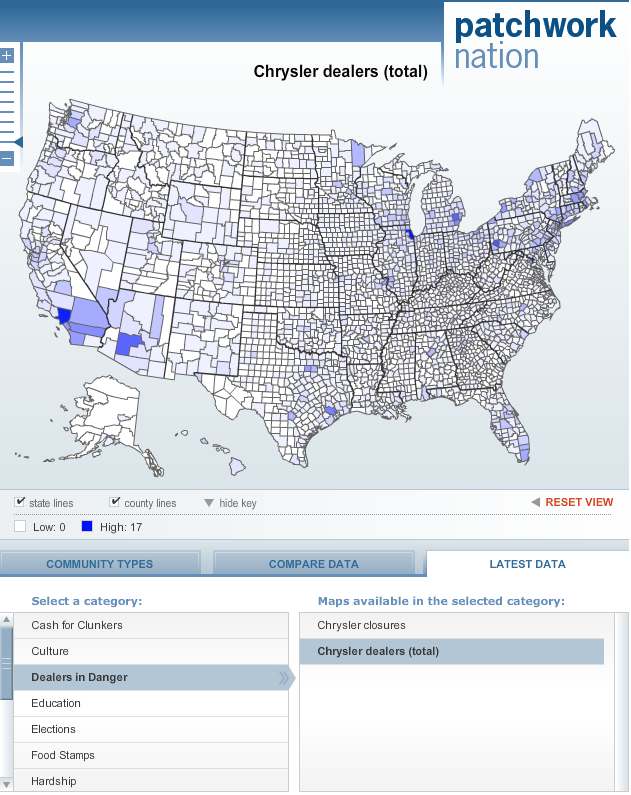 This is a totally uber groovy tool that allows you to visualize the economic impact of the recession in new and interesting ways. From foreclosures to how many Chrysler dealers are in danger of losing their franchises, Patchwork Nation will show you our economy in a whole new light.
Apple’s Worst Security Breach: 114,000 iPad Owners Exposed | Fast Company
It doesn’t stop there. According to the data we were given by the web security group that exploited vulnerabilities on the AT&T network, we believe 114,000 user accounts have been compromised, although it’s possible that confidential information about every iPad 3G owner in the U.S. has been exposed.
“Daddy, What’s a Brand?” and 9 More Awkward Questions for Uncertain Times | Fast Company

For a brand, nirvana is when your good name is so widely endorsed that it enters the language. “Pass the Kleenex.” “Google it.”
 Dispatches From The Front