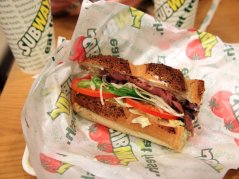
 Subway is about to get a big makeover. The sandwich chain, which has recently been plagued by declining sales and a scandal involving its former spokesman Jared Fogle, will undergo its first brand overhaul in seven years, reports Josh Kosman at The New York Post. Subway’s US sales last year fell by 3%, the most of any of the top 25 fast-food chains, Drew Harwell reports at The Washington Post. Subway also fell two spots to become the third-most-popular fast-food restaurant for the first time in seven years. Here are the changes Subway is considering.
Author: knjohn
Mount McKinley’s Alaska name Denali is restored by Obama | BBC News
 After decades of controversy, the name of Mount McKinley, the tallest mountain in North America, has been changed back to its original native Alaskan, Denali. Denali translates as High One or Great One and is used widely by locals. The 20,237ft (6,168m) peak was named by a gold prospector in 1896 after he heard that William McKinley had been nominated to become the US president. US President Barack Obama announced the change ahead of a three-day visit to Alaska to highlight climate change.
Freelancing: A New Business Concept that is set to take the Commercial Realm by Storm | Cool Business Ideas
 Perhaps ten years back, the idea of freelancing was not as appealing as it is today. Even three or four years ago the proposition of going the freelancing way was all about particular skill sets including designers/web developers, copywriters and illustrators. Today however, in the age of start-up boom anyone with the following skills can look forward to raking in the moolah:
Full service blogging
Metrics Analytics
Startup Video Producing
Food styling Podcasting
Others
The post, however, is not about the new opportunities to be explored in freelancing but more about ways to succeed as a freelancer. Freelancing does spell a lot of freedom initially. However, freedom, here, cannot be equated with lack of planning or discipline. Here is a look at the infallible tips to succeed in freelancing. Here’s your chance to explore more of what you already love doing. Read on.
How to Use Salary Caps to Sustainably Scale Your Small Business | Page19
 How can a small business grow sustainably? Greg Crabtree and Beverly Blair Harzog think that in a growing business, staffing costs can quickly balloon out of control. When small businesses are making the transition to medium-sized businesses, it’s possible to fall into a dangerous feedback loop of borrowing and spending. As you scale your business, your costs grow, and it’s tempting to see breaking even—your previous measure of success—as sufficiently safe growth.
However, medium-sized businesses have vastly larger costs, and can’t afford the breakneck growth speed that smaller, more agile operations can attain. As your costs grow, it’s important to retain control over those which you have the power to influence—and the biggest of these is labor costs.
Kraft: Warren Buffett, 3G Capital May Push Cost-Cutting |Bloomberg Business
 For decades, Kraft and other food behemoths offered convenience, comfort, and the promise of a modern lifestyle. But the compound annual growth rate of the packaged food industry in North America has been less than 1 percent for almost 10 years, with Big Food losing market share to smaller, healthier brands. Venerable Kraft Foods—whose Singles are a “processed cheese product,” and whose Cool Whip didn’t contain milk or cream until five years ago—has lost revenue for the past three years. “Now these big food brands are old-fashioned,” says Bob Goldin, chief executive officer at researcher Technomic. “Consumers don’t see them as relevant.”
But investors, well, that’s a different matter. Warren Buffett—who drinks Coke at breakfast and says he eats like a 6-year-old—teamed up with 3G Capital, the private equity firm founded by some of Brazil’s wealthiest men and known for its penny-pinching ways at Anheuser-Busch InBev and Burger King, to buy ketchup maker Heinz in 2013. In July, Heinz closed on its purchase of Kraft, with Buffett’s Berkshire Hathaway and 3G owning a 51 percent stake. Kraft Heinz instantly became the third-largest food company in North America, with global sales of $29 billion last year. The good news is it’s composed of big, profitable brands. The bad: They have little potential to grow. “What can they do with these brands?” says Bloomberg Intelligence analyst Kenneth Shea. “They’ll do the best they can, but mostly they’ll cut costs.”
The Basics of How I Built a Seven-Figure Business Without Employees | Entrepreneur
 There is a lot to be said for those rare few that possess the ability to create huge companies with hundreds or thousands of employees that are all just ecstatic to be at work. It is exceptionally difficult and equally as impressive, which is why they end up taking up space on the front page of a major magazine or journal.
Although it appears flashy and glamorous, particularly with the amount of celebrity that todays super entrepreneurs wield, there is a tremendous amount of flexibility that is lost, almost by default, once you pass a certain size. Now, not only am I not one of those few, but I really don’t want to be.
Authority Marketing: How To Measure Up In Front of Customers | Small Biz Trends
 You’re a liar. At least, that’s what you’re afraid people will find out about you.
The smaller your business, the more likely you are to have had this thought at one point: My product/service is just the latest form of snake oil and everyone is about to find out.
First off, take a deep breath.
Dealing with this thought (often referred to as ‘impostor syndrome’) is completely normal. Some of the most talented people in the world have suffered from it. (Tina Fey and Maya Angelou are just a few of the celebrities that have admitted to suffering from impostor syndrome.)
Generally speaking, the harder you’ve had to work in life to succeed, the more likely you are to feel that fear of being exposed as a fraud.
U.S. Sees Big Spike in Black and Hispanic Women Entrepreneurs | Money Cnn
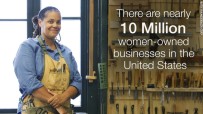 When it comes to small business in the United States, more women are running the show.
On Wednesday, the National Women’s Business Council released an analysis of preliminary Census data which showed there were nearly 10 million women-owned small businesses in the U.S. in 2012, a 27.5% increase from 2007. (The Census defines a woman-owned business as one where a woman owns 51% or more of the business equity or stock).
While men still own more businesses than women, women-owned businesses grew at a rate of four times that of male-owned businesses. In 2012, men owned nearly 15 million businesses.
Overall, women-owned businesses earned a total of $1.6 trillion between 2007 and 2012 and the vast majority (89.4%) were run by sole proprietors, meaning the only employee was the owner.
The report, which pulled data from the Census’s Survey of Small Business Owners, also highlighted major increases in small business ownership among women of color, particularly black and Hispanic women.
Weekly Economic Update | LAEDC
 v.19 n. 35 – Released August 25, 2015
This Week’s Headlines:
- July State and Local Employment Report
- SoCal Home Prices and Median Prices in July
- Events of Interest
- September 30: LAEDC Fall Economic Forecast
- October 13: Southern California Visitor Industry Outlook Conference
- October 30: 2015-16 South Bay Economic Forecast Conference
Investigating Applicants Is Not a Luxury | Payroll Link
 The trend in hiring is toward intensive pre-screening of job applicants. In our mobile society it’s rare to have firsthand knowledge of a new hire. And the days are gone when an employer would dare hire based solely on a grade point average and a transcript from a school or college.
Now an employer needs to know more about an applicant — much more. Otherwise, the employer risks hiring problems.
With fierce competition for a limited number of jobs, applicants may exaggerate and embellish the experience they have — or don’t have. They may also try to hide things like a criminal record or previous termination.
To a busy employer, background checks on applicants can seem like a luxury, a task that requires more resources or time than is available. But failing to do good background checks will hurt your bottom line and dull your competitive edge in these ways:

