 For residents of minority urban neighborhoods, access to Amazon.com’s vast array of products—from Dawn dish soap and Huggies diapers to Samsung flatscreen TVs—can be a godsend. Unlike whiter ZIP codes, these parts of town often lack well-stocked stores and quality supermarkets. White areas get organic grocers and designer boutiques. Black ones get minimarts and dollar stores. People in neighborhoods that retailers avoid must travel farther and sometimes pay more to obtain household necessities. “I don’t have a car, so I love to have stuff delivered,” says Tamara Rasberry, a human resources professional in Washington, D.C., who spends about $2,000 a year on Amazon Prime, the online retailer’s premium service that guarantees two-day delivery of tens of millions of items (along with digital music, e-books, streaming movies, and TV shows) for a yearly $99 membership fee. Rasberry, whose neighborhood of Congress Heights is more than 90 percent black, says shopping on Amazon lets her bypass the poor selection and high prices of nearby shops.
Author: knjohn
How Your Small Business Can Benefit From ‘Keep it Simple’ Selling | All Business
 Albert Einstein once said, “Things should be as simple as possible, but not simpler.” I agree. These words certainly apply to selling. Here’s how to keep it simple.
Simplify your number of offerings.
Some salespeople have to write proposals to make their sales, and others don’t ever write proposals. Whether you write proposals or not, you need to decide how many choices to present to your customers. Some salespeople think that offering a lot of choices is better to make more sales. They’re wrong. Salespeople should offer fewer choices to simplify their selling.
Here’s why. If you offer too many choices, you overload your customers–it makes it harder for them to make buying decisions. This may have happened to you when you were trying to make a purchase. It recently happened to me.
Weekly Economic Report | LAEDC
 v.20 n.17 – Released May 16, 2016
This Week’s Headlines:
- California Financial Report for April
- Retail Sales Rebound in April
- Events of Interest
- June 16-17, 2016: Select L.A. International Investment Summi
Nobody Saw This Volcano Erupt … Except NASA’s Satellites | Live Science
 For the first time in 60 years, Mount Sourabaya erupted with a spectacular show of fiery lava — in fact, it erupted twice. But there wasn’t a single human soul who saw the eruptions live; nobody lives on the volcano’s remote island in the South Atlantic Ocean, according to NASA Earth Observatory.
Instead, satellites captured images of the eruptions, which happened on April 24 and May 1, 2016, NASA reported.
Volcanic eruptions in far-flung places, such as the South Atlantic, used to go unnoticed. But the advent of satellites and seismic monitoring has given scientists new insight into volcanic events worldwide, NASA officials said.
Jail sentence for YouTube pranksters | BBC News
 Four members of the controversial Trollstation YouTube channel have been jailed in connection with fake robberies and kidnappings.
The group were involved in a fake robbery at London’s National Portrait Gallery and a fake kidnapping at Tate Britain in July 2015.
The channel, with 718,000 subscribers, has built a reputation for filming staged pranks around the city.
A fifth member was imprisoned in March following a bomb hoax.
“The hoaxes may have seemed harmless to them, but they caused genuine distress to a number of members of the public, who should be able to go about their daily business without being put in fear in this way.
Helping Your Best Employees Leave You | Inc.com
 One of the things I am most proud of as the 20 year owner of my executive sales firm Corporate Rain International is how many employees and associates have left me to take a leadership role at other companies or to start their own ventures. While I see a multitude of articles written about holding on to great employees, I never see an article about celebrating an employee assuming greater leadership and greater personal growth by leaving.
There should be more discussion of this, particularly in the small business universe. I believe in supporting employee growth and fulfillment even to the point of their leaving your company. I see this as a fundamental step in creating good through-branded culture.
8 Reasons Great Employees Quit (Even Though They Like The Job) | Life Hack
 There are many reasons why people change jobs. These days, it is uncommon for someone to get a job and stick with it for the rest of their life. There are many opportunities and our lives are filled with diversity and flexibility. However, there are often patterns to why people decide to move on from what seemingly is ideal employment — and it isn’t just about the money or the location.
Here are eight common reasons why someone might quit their job.
YouTube tests an in-app messenger for sharing videos with friends | TechCrunch
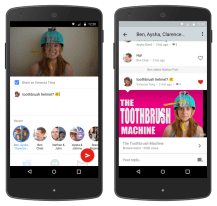 YouTube as a messaging app? Sure, why not! Everyone’s doing it, after all. In case you missed it: YouTube announced this week that it’s testing a new feature with a subset of its mobile app user base that will allow them to easily share videos with family and friends. Users with the feature can chat about those videos in a new tab in the app, the company says.
The feature makes sense, as a lot of YouTube’s user base already shares videos with their friends – but over SMS, iMessage or another messaging platform. YouTube is smart to try to capitalize on that behavior, in order to increase usage of its own app as well as the time its users spend engaged with its service on mobile.
How Women Are Leading The Charge In Changing Healthcare | Forbes
 Just one in seven mental health patients are getting effective care, according to Lyra Health’s Dena Bravata. Could a Match.com-style doctor matching service change that statistic?
“You might prefer someone who’s near your office or speaks Swahili or whatever your preferences are,” Bravata said at the Forbes Women’s Summit, speaking on the New Frontiers in Healthcare panel. You should be able to find that, and her company will help you do it.
Lyra was just one of several healthcare companies touted during the panel as a new look at personalized medicine–one of several helmed by women.
“We’re transforming from a passive patient to an empowered patient,” MedImmune head Bahija Jallal said by way of introduction. And in the new world of patient empowerment, that could mean anything from finding your own doctor to taking on decades of standard healthcare practice.
The You You Never Knew: 7 Surprising Things You Didn’t Know About Yourself | Page19
 In just three lines of verse, Walt Whitman touches on a critical aspect of what it is to be human: knowing that not only is each one of us a world to ourselves, but that within those worlds lies a bevy of opportunities for surprise.
But when was the last time you actually surprised yourself? After all, it’s easy to get caught up in comforting confirmation biases and pleasant patterns that support what you already know. For this reason, reading self-help books that interest you might not help you learn anything new at all. Alternatively, you could go around and quiz the people in your life about what they’ve observed about you. Unfortunately, this might be less enjoyable for them than it is for you.

